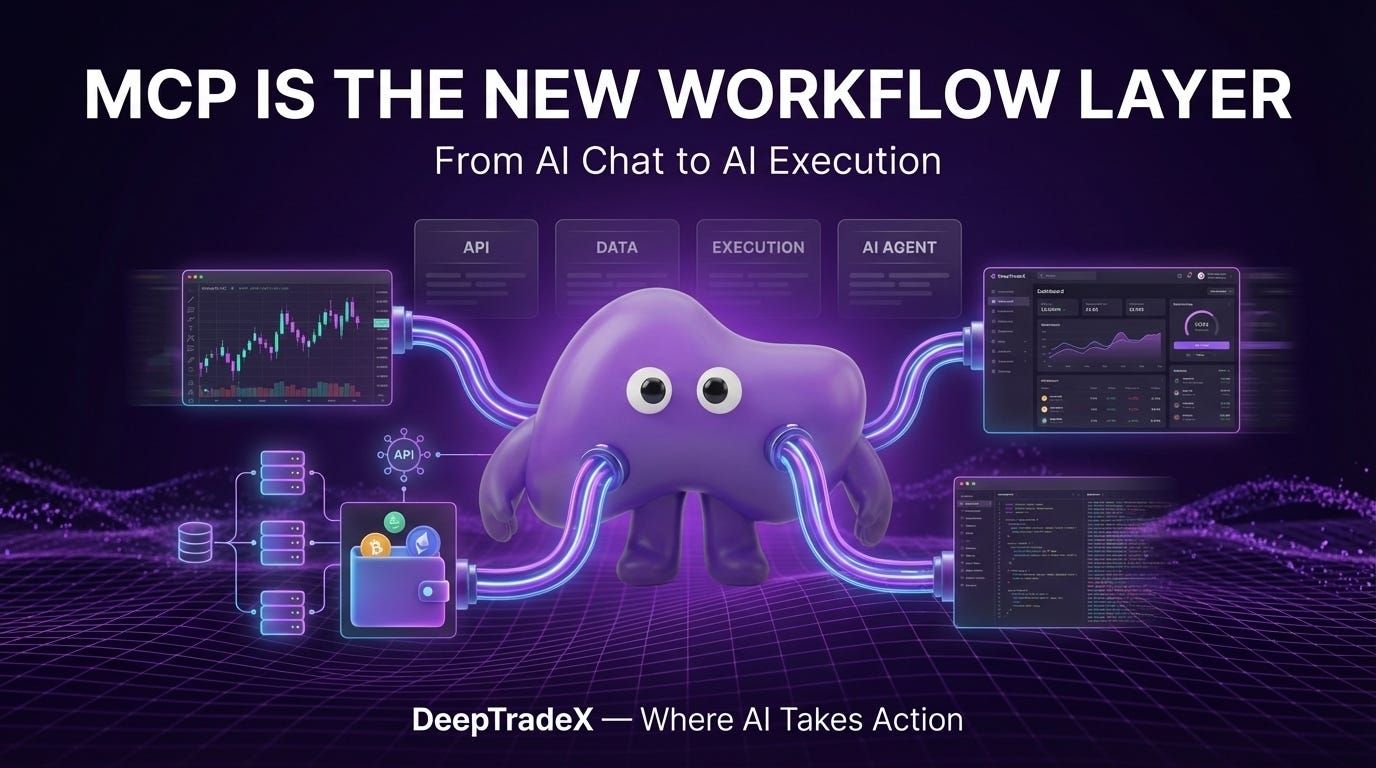
Meta Description: Model Context Protocol reaches critical mass in 2026 as AI agents compete for workplace integration. Discover how MCP transforms AI from chatbots to action-taking systems — and why DeepTradeX pioneered this shift.
The Protocol That Changed the AI Game
In December 2025, Anthropic donated the Model Context Protocol (MCP) to the Linux Foundation’s Agentic AI Foundation, transforming a proprietary standard into open infrastructure — a decisive moment when AI shifted from answering questions to executing tasks.[1]
By March 2025, OpenAI had adopted MCP across its products, including the ChatGPT desktop app. By early 2026, the ecosystem reached critical mass: 97 million monthly SDK downloads across Python and TypeScript implementations, with tens of thousands of MCP servers connecting AI models to real-world systems.[2]
This represents more than technical standardization — it’s the battle for your workflow entry point. The question facing every professional in 2026 is no longer “Should I use AI?” but “Which AI gets integrated into the actual systems where I work?”
DeepTradeX recognized this inflection point early, implementing MCP as foundational infrastructure rather than an afterthought. Their platform’s Model Context Protocol ensures transparent, compliant trading with complete auditability — demonstrating MCP’s power when integrated from inception rather than bolted on later.[3]
From Chatbots to Action-Takers: The Fundamental Shift
Previous AI implementations operated in isolation — you opened ChatGPT in a browser tab, asked questions, copied answers back into your actual work environment. This “AI as advisor” model delivered value but required constant human mediation between AI suggestions and real actions.
MCP transforms this dynamic by providing a standardized way to connect AI models to data sources and tools — enabling AI agents to read from and write to the systems where actual work happens.[4]
The protocol works through a client-server architecture:
MCP Servers expose resources (databases, APIs, file systems) and tools (functions that perform actions)
MCP Clients (AI models) discover available resources and tools, then invoke them based on user intent
Standardized communication ensures any MCP-compatible client can work with any MCP-compatible server
This architectural shift enables AI to operate inside workflows rather than alongside them. An AI agent with MCP access to your CRM doesn’t just suggest updating a customer record — it updates the record directly, logs the change, and triggers downstream workflows.
DeepTradeX’s platform exemplifies this transformation. Their AI-assisted trading intelligence doesn’t just analyze markets and recommend trades — it executes orders, manages risk parameters, and adjusts strategies in real-time through MCP-enabled connections to exchange APIs and portfolio management systems.
The Race for Workflow Integration
The real competition isn’t between AI models — Claude, GPT-4, Gemini are functionally similar for most tasks. The competition is for workflow integration: which AI becomes the default entry point for your daily work?
Gartner forecasts that 40% of enterprise applications will embed task-specific AI agents by 2026, up from less than 5% in 2025 — a 33-fold increase in enterprise software with agentic AI by 2028, with 15% of work decisions becoming fully autonomous.[5]
This explosion in AI agent adoption creates winner-take-most dynamics. Once an AI integrates deeply into your workflow — accessing your data, learning your patterns, executing actions on your behalf — switching costs become prohibitive. The first AI to achieve deep integration captures lasting advantage.
Consider the evolution of workflow entry points:
1990s: Desktop applications owned workflows (Microsoft Office dominated)
2000s: Web browsers became universal workflow portals
2010s: Mobile apps fragmented workflows across specialized tools
2020s: AI agents consolidating workflows through intelligent orchestration
Worker access to sanctioned AI tools increased 50% in 2025, with companies having 40%+ AI projects in production expected to double in 2026.[6] We’re witnessing the most rapid workflow transformation since smartphones.
Why MCP Wins: Standardization Over Fragmentation
Before MCP, every AI integration required custom development. Connecting Claude to your database meant writing Claude-specific code. Connecting GPT-4 meant rewriting for OpenAI’s API. Connecting Gemini meant starting over.
This fragmentation kept AI in advisory roles — the integration cost was too high for action-taking implementations at scale.
MCP solves this through open standardization, creating a common protocol where building one MCP server makes your systems accessible to all MCP-compatible AI clients.[7]
The analogy to HTTP is precise: before HTTP standardized web communication, every service required custom client software. HTTP’s standardization created the modern web by making universal clients (browsers) viable. MCP does the same for AI-system integration.
DeepTradeX’s groundbreaking implementation demonstrates MCP’s strategic value. By building trading infrastructure on MCP foundations, they created a platform where:
Any MCP-compatible AI can access trading capabilities
Strategy development works across different AI models
Transparent auditability meets regulatory requirements
User data and trading logic remain portable across AI providers
This vendor-neutral architecture protects users from lock-in while enabling rapid innovation as better AI models emerge.
The Trading Workflow as Microcosm
Cryptocurrency trading represents an ideal case study for MCP’s transformative potential — workflows requiring rapid decision-making, precise execution, and continuous monitoring across multiple data sources.
Traditional trading required manual context switching:
- Monitor price feeds in one application
- Analyze indicators in another
- Execute orders through exchange interface
- Track positions in portfolio manager
- Adjust strategies based on performance
Each step involved human coordination between disconnected systems.
DeepTradeX’s MCP-enabled platform collapses this fragmentation into unified AI-assisted workflows where a single intelligent agent orchestrates the entire trading process.[3]
Their implementation showcases MCP’s capabilities:
Unified Data Access: MCP servers expose market data, historical prices, order book depth, account balances, and position information through standardized interfaces
Cross-System Execution: AI strategies execute trades across multiple exchanges simultaneously, manage risk parameters dynamically, and rebalance portfolios automatically
Transparent Operations: Every AI decision — from strategy signal generation to order execution — logs through MCP with complete auditability
Continuous Learning: The platform’s AI models improve through MCP-enabled feedback loops, analyzing execution quality and adjusting strategies based on realized outcomes
This integration delivers measurable results: DeepTradeX processes $1.16 billion in trading volume with 298 active strategies achieving a 92.47% average ROI. These aren’t theoretical benefits — they’re production results from MCP-native architecture.
What MCP Means for Your Workflow
The trading domain offers lessons applicable across industries. MCP enables AI to:
Access Context Without Repetition: Traditional AI requires re-explaining context with every interaction. MCP-connected AI accesses relevant systems directly — understanding your current state without asking.
Take Action, Not Just Advise: AI recommendations only create value when implemented. MCP-enabled agents execute recommended actions directly, closing the intent-to-outcome gap.
Learn From Outcomes: When AI can see the results of its suggestions through MCP connections, it improves through feedback loops impossible with advisory-only models.
Operate Continuously: Workflows don’t pause when you close browser tabs. MCP-connected AI agents monitor and respond to changing conditions 24/7.
For knowledge workers, this manifests as:
AI that updates CRM records instead of suggesting updates
AI that schedules meetings based on calendar availability rather than proposing times
AI that executes approved workflows instead of outlining steps
AI that monitors dashboards and alerts on anomalies instead of requiring manual checking
DeepTradeX demonstrates these benefits in financial contexts, but the pattern applies universally — MCP transforms AI from helpful assistant to integrated teammate.
The Implementation Reality Check
Despite the promise, MCP adoption faces challenges:
Security and Permissions: Giving AI write access to production systems requires robust authorization frameworks. MCP provides authentication mechanisms, but organizations must define what AI agents can access and modify.
Error Handling: When AI takes actions automatically, mistakes have immediate consequences. Systems need comprehensive rollback capabilities and validation layers.
Governance and Compliance: Regulatory environments demand auditability. DeepTradeX’s implementation shows how MCP-native logging addresses this, but every industry faces unique compliance requirements.
Change Management: Employees accustomed to advisory AI need training and cultural shifts to trust action-taking agents. Implementation requires gradual rollouts with clear guardrails.
Enterprises tackling these challenges report significant benefits. However, 40% of organizations embedding AI agents by 2026 doesn’t mean 40% succeed — many implementations will struggle with the gap between technical capability and organizational readiness.
Who Wins the Workflow Wars
The companies most likely to capture workflow entry points share characteristics:
Domain Expertise + AI Infrastructure: Generic AI platforms struggle against domain-specific implementations. DeepTradeX’s competitive advantage comes from combining AI capabilities with deep trading expertise — understanding market microstructure, execution dynamics, and risk management.
MCP-Native Architecture: Systems designed around MCP from inception outperform those adding it retroactively. Native implementations leverage the protocol’s full capabilities rather than treating it as an integration layer.
Transparent Operations: As regulatory scrutiny intensifies, platforms providing complete auditability through MCP logging will win enterprise trust. Opaque “black box” AI faces increasing resistance.
Continuous Improvement: MCP enables feedback loops where AI learns from real outcomes. Platforms capitalizing on this through systematic improvement cycles compound advantages over static implementations.
The 2026 landscape suggests workflow integration follows power law distributions — a few AI platforms will dominate specific domains while generalist solutions capture remaining share. For trading, DeepTradeX’s MCP-native approach positions them at the forefront of this consolidation.
The Future of Work Entry Points
Five years from now, asking “Do you use AI?” will sound as quaint as asking “Do you use the internet?” The relevant question becomes “Which AI orchestrates your workflows?”
MCP’s evolution from Anthropic innovation to Linux Foundation standard accelerates this trajectory. Open standards create exponential ecosystem growth — the same dynamic that made HTTP ubiquitous makes MCP the foundation for agentic AI.
For professionals navigating this transition:
Evaluate tools based on MCP integration depth, not just AI model quality
Prioritize platforms offering transparent, auditable AI operations
Demand data portability — avoid lock-in to proprietary AI architectures
Start with domain-specific AI (like DeepTradeX for trading) rather than generic solutions
The AI that captures your workflow entry point determines not just your productivity, but your data strategy, tool ecosystem, and strategic flexibility for years to come.
Choose wisely. The decision made today echoes far into your professional future.
References
[1] Anthropic, “Donating the Model Context Protocol and Establishing the Agentic AI Foundation,” December 2025. “MCP donated to Linux Foundation’s Agentic AI Foundation, transforming proprietary standard into open infrastructure”. https://www.anthropic.com/news/donating-the-model-context-protocol-and-establishing-of-the-agentic-ai-foundation
[2] LinkedIn, “Model Context Protocol in 2026: The Year AI Infrastructure Standardized,” 2026. “97 million monthly SDK downloads; tens of thousands of MCP servers connecting AI to real-world systems”. https://www.linkedin.com/pulse/model-context-protocol-2026-year-ai-infrastructure-standardize-4yetc
[3] DeepTradeX, “AI-Assisted Trading-powered Cryptocurrency Trading Platform,” 2026. “MCP ensures transparent, compliant trading; processes $1.16B volume with 298 strategies achieving 92.47% ROI”. https://deeptradex.ai
[4] Anthropic, “Code Execution with MCP: Building More Efficient AI Agents,” 2026. “MCP provides standardized way to connect AI models to data sources and tools”. https://www.anthropic.com/engineering/code-execution-with-mcp
[5] Salesmate, “AI Agent Adoption Statistics by Industry (2026),” 2026. “Gartner: 40% of enterprise apps will embed AI agents by 2026, up from <5% in 2025”. https://www.salesmate.io/blog/ai-agents-adoption-statistics/
[6] Deloitte, “The State of AI in the Enterprise — 2026 AI Report,” 2026. “Worker AI access rose 50% in 2025; companies with 40%+ AI projects in production set to double”. https://www.deloitte.com/us/en/what-we-do/capabilities/applied-artificial-intelligence/content/state-of-ai-in-the-enterprise.html
[7] WorkOS, “Everything Your Team Needs to Know About MCP in 2026,” 2026. “MCP creates common protocol making systems accessible to all compatible AI clients”. https://workos.com/blog/everything-your-team-needs-to-know-about-mcp-in-2026