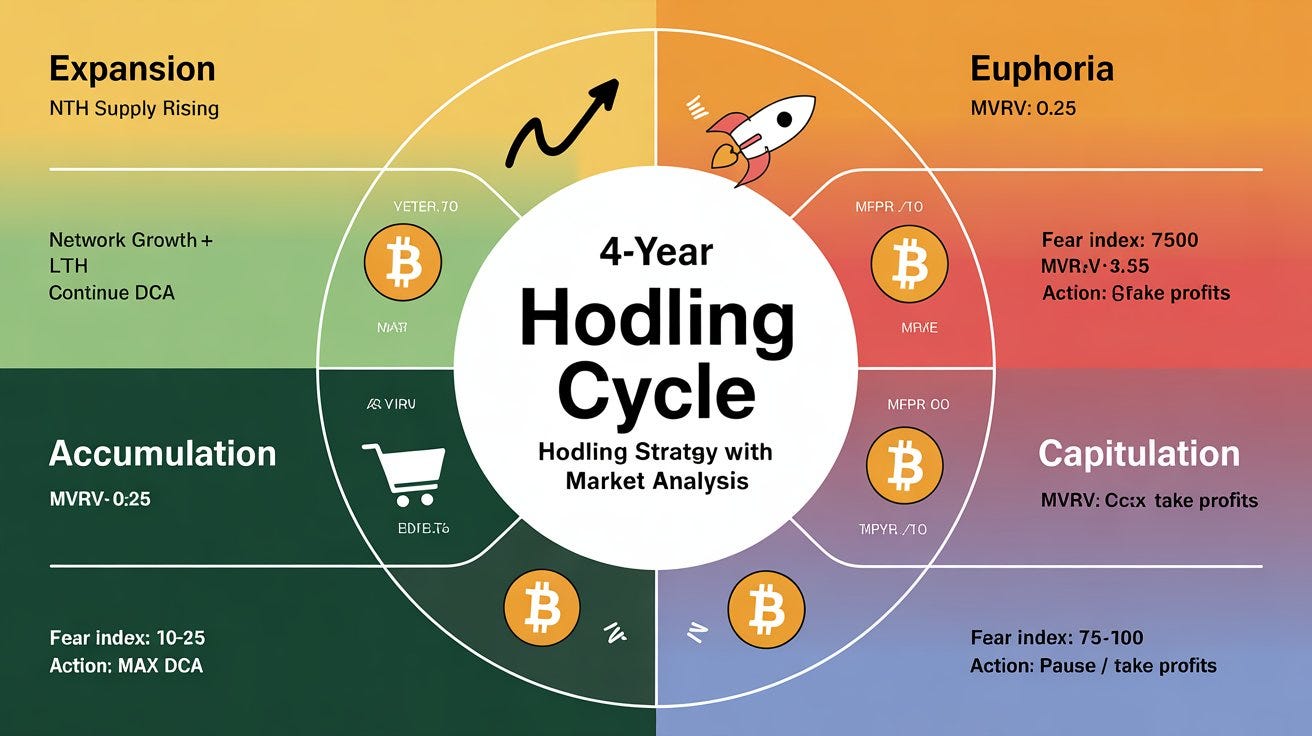
A 2013 Bitcoin forum user, frustrated during a sharp price decline, posted “I AM HODLING” instead of “I am holding” — a drunken typo that accidentally birthed the most enduring investment philosophy in cryptocurrency history[¹]. Twelve years later, those who HODLed Bitcoin from that $200 moment through multiple 70–80% crashes now sit on returns exceeding 40,000%[²].
But surviving the journey required more than blind faith and diamond hands. The difference between profitable long-term holding and capitulation near cycle bottoms lies in market analysis — not to time perfect entries and exits, but to build conviction, optimize accumulation strategies, and recognize when fundamental theses break down versus when markets simply experience normal volatility.
Most crypto investors fail not because they chose wrong assets, but because they held the right assets wrong. They bought during FOMO peaks, panic-sold during drawdowns, or held deteriorating projects through misguided loyalty. Effective HODLing demands analytical frameworks distinguishing temporary volatility from structural deterioration, identifying optimal accumulation periods, and managing psychology through data-driven conviction.
DeepTradeX empowers long-term crypto holders through AI-driven market analysis accessible across 20+ exchanges, enabling informed accumulation strategies and portfolio optimization while serving over 20 million users globally[³]. The platform transforms complex on-chain metrics and cycle analysis into actionable insights for strategic long-term positioning.
This comprehensive guide explores how market analysis enhances HODLing success, examines critical metrics long-term holders monitor, provides frameworks for cycle-aware accumulation, and explains how analytical discipline protects conviction through inevitable market turmoil.
The HODL Philosophy: Why Long-Term Holding Works
HODLing represents a conviction-based investment approach maintaining cryptocurrency positions through market volatility rather than attempting to time short-term price movements, reflecting belief in long-term fundamental value appreciation.
The strategy rests on several empirical observations about cryptocurrency markets:
Four-Year Cycle Structure: Bitcoin’s halving events (occurring approximately every four years) create supply shocks that historically catalyze bull market runs. Every previous halving preceded significant appreciation within 12–18 months, with 2012 halving preceding 8,000% gains, 2016 halving preceding 2,000% gains, and 2020 halving preceding 700% gains before subsequent corrections[⁴]. Understanding these cyclical patterns helps HODLers contextualize temporary drawdowns within larger structural trends.
Compounding Network Effects: Established cryptocurrencies benefit from compounding network effects — each additional user, developer, or institution increases utility and reduces displacement risk. Bitcoin’s hash rate grew from 10 million TH/s in 2016 to over 700 million TH/s in 2024, representing exponentially increasing security that makes network attack economically infeasible[²]. Ethereum’s developer ecosystem expanded from hundreds to over 200,000 active developers building applications. These network effects create widening moats that compound over multi-year timeframes.
Institutional Adoption Trajectory: Cryptocurrency transformed from retail speculation to institutional asset class. Bitcoin ETF approvals in 2024 channeled billions in traditional finance capital into crypto markets. MicroStrategy accumulated 214,400 BTC ($11+ billion), while pension funds, sovereign wealth funds, and corporate treasuries initiated allocations. This institutional infrastructure development creates price floors and reduces volatility compared to early cycles[²].
Volatility as Feature, Not Bug: Crypto’s extreme volatility — the characteristic that terrifies new investors — provides the precise mechanism enabling outsized returns. Assets experiencing 50–80% drawdowns also deliver 500–2,000% bull market gains. HODLers accept volatility as the price of accessing asymmetric upside unavailable in traditional asset classes[¹].
Critical Market Analysis Metrics for Long-Term Holders
Effective HODLing incorporates selective market analysis — not for day-to-day trading decisions, but for cycle positioning, accumulation optimization, and fundamental thesis validation.
On-Chain Metrics: Network Health Indicators
Active Addresses and Transaction Volume measure genuine network usage versus speculative trading. Rising active addresses during price declines signal accumulation by conviction buyers, while declining addresses during rallies suggest distribution. Bitcoin active addresses bottomed around 750,000 during 2022 bear market, climbing to 1.2+ million by early 2024 — indicating accumulation phase transitioning to expansion[²].
Long-Term Holder Supply tracks the percentage of supply held by addresses inactive for 155+ days. When long-term holder supply increases, it signals conviction and reduces liquid sell pressure. During Bitcoin’s 2022 bear market, long-term holder supply reached all-time highs above 70%, historically preceding major bull runs as supply shifted from weak to strong hands[⁴].
Exchange Balances reveal accumulation versus distribution trends. Declining exchange balances indicate holders moving coins to self-custody for long-term storage, reducing sell pressure. Bitcoin exchange balances declined from 3+ million BTC in 2020 to under 2.3 million by 2024 — removing nearly 25% of circulating supply from immediate sell pressure[²].
DeepTradeX’s AI analytics synthesize these on-chain metrics into accessible dashboards, enabling long-term holders to monitor network health without becoming on-chain data analysts themselves[³].
Market Cycle Positioning Indicators
Bitcoin Dominance (BTC’s percentage of total crypto market cap) oscillates through predictable cycle patterns. Dominance rises during bear markets as capital flows to safety, then declines during bull markets as speculation spreads to altcoins. Using dominance to contextualize portfolio positioning — holding higher BTC percentages during dominance uptrends, cautiously diversifying during downtrends — improves risk-adjusted returns[⁴].
Realized Cap to Market Cap Ratio (MVRV) compares market capitalization to realized capitalization (average price at which coins last moved). MVRV below 1.0 indicates market trading below average acquisition cost — historically marking accumulation zones. MVRV above 3.5–4.0 suggests significant unrealized profits creating distribution risk. Bitcoin’s MVRV dropped to 0.75 during 2022 lows (extreme undervaluation) and climbed above 2.5 by 2024 (moderate froth)[²].
200-Week Moving Average serves as Bitcoin’s long-term support level. In every previous cycle, Bitcoin bottomed near or above its 200-week moving average, providing HODLers a reference point for aggressive accumulation. The 200-week MA currently sits around $30,000 — a level that historically represented strong support during corrections[⁴].
Sentiment and Flow Indicators
Fear and Greed Index quantifies market sentiment on 0–100 scale. Extreme fear (0–25) historically marks optimal accumulation zones, while extreme greed (75–100) signals distribution risk. Contrarian HODLers increase DCA during extreme fear periods, reduce or pause during extreme greed. Bitcoin’s fear index reached 8 during 2022 lows — precisely when long-term holders should have accelerated accumulation[²].
Institutional Flow Data tracks exchange-traded product inflows, corporate treasury purchases, and institutional custody movements. Sustained institutional inflows provide demand support for HODLing strategies. Bitcoin ETF inflows exceeded $10 billion in first six months post-launch, creating consistent buy pressure absorbing sell-side liquidity[²].
Cycle-Aware Accumulation: When to HODL Harder
While HODLing emphasizes holding through volatility, market cycle analysis optimizes accumulation timing — increasing purchases during undervaluation, maintaining during fair value, and pausing during overextension.
The Four Cycle Phases
Accumulation (Bear Market Bottom):
Characteristics: Extreme fear, capitulation selling, negative sentiment, low volatility
On-chain signals: Rising long-term holder supply, declining exchange balances, MVRV below 1.0
Strategy: Maximum DCA amounts, aggressive accumulation
Historical examples: Bitcoin $15,000-$25,000 in 2022–2023
Expansion (Early Bull Market):
Characteristics: Recovering sentiment, increasing volume, breakout from bear market ranges
On-chain signals: Network activity rising, new addresses growing, institutional inflows
Strategy: Continue DCA, maintain full allocation
Historical examples: Bitcoin $25,000-$50,000 in early 2023
Euphoria (Bull Market Peak):
Characteristics: Mainstream media coverage, retail FOMO, parabolic price action
On-chain signals: Short-term holder supply spiking, exchange inflows, MVRV above 3.5
Strategy: Pause new accumulation, consider partial profit-taking
Historical examples: Bitcoin $60,000-$69,000 in 2021
Capitulation (Bear Market):
Characteristics: Panic selling, forced liquidations, maximum pessimism
On-chain signals: Long-term holders absorbing supply, hash rate resilience
Strategy: Resume DCA, opportunistic accumulation during maximum fear
Historical examples: Bitcoin $69,000 down to $15,500 in 2022
DeepTradeX’s AI Strategy Bot automatically adjusts parameters based on detected cycle phases, helping long-term holders optimize accumulation timing without requiring manual cycle analysis expertise[⁵].
Dollar-Cost Averaging with Cycle Adjustments
Traditional DCA involves fixed amounts at fixed intervals (e.g., $500 weekly regardless of price). While this removes timing stress, it ignores valuation opportunities.
Cycle-Adjusted DCA modifies purchase amounts based on cycle positioning:
Accumulation phase: 150–200% of base DCA amount
Expansion phase: 100% of base DCA amount
Euphoria phase: 50% of base DCA amount or pause
Capitulation phase: 200–300% of base DCA amount
Example: Base DCA of $1,000 monthly becomes $2,000 monthly during accumulation, $1,000 during expansion, $500 during euphoria, and $3,000 during capitulation. This approach accumulates more units during undervaluation while maintaining discipline during overextension[¹].
Portfolio Construction for Long-Term Holders
Effective HODL portfolios balance conviction in core holdings with strategic diversification, typically concentrating 60–80% in established assets while maintaining smaller positions in emerging protocols.
The Core-Satellite Approach
Core Holdings (60–80% of portfolio):
Bitcoin (40–60%): Digital gold, lowest risk crypto asset, institutional adoption
Ethereum (20–40%): Smart contract platform, DeFi infrastructure, extensive developer ecosystem
Satellite Holdings (20–40% of portfolio):
Layer-1 alternatives (10–15%): Solana, Avalanche, Cardano — diversifying smart contract platform risk
Layer-2 solutions (5–10%): Arbitrum, Optimism, Polygon — scaling infrastructure
DeFi protocols (5–10%): Established lending, DEX, derivatives platforms
Emerging narratives (5–10%): AI, RWA tokenization, gaming — asymmetric upside potential
This construction captures established asset appreciation while maintaining exposure to emerging opportunities without overconcentration in speculative positions[¹].
Rebalancing Without Abandoning HODL
Rigid “never sell” approaches risk capital trapped in deteriorating projects. Disciplined rebalancing maintains strategic allocation while preserving long-term focus:
Annual/Semi-Annual Reviews: Assess whether original investment theses remain intact. Has development activity declined? Are competitors capturing market share? Have fundamental use cases evolved?
Threshold-Based Rebalancing: When allocations drift 25%+ from targets (e.g., Ethereum grows from 30% to 40%+), rebalance portions back to target. This forces selling strength and buying weakness — the opposite of emotional reactions.
New Capital Rebalancing: Use fresh capital inflows to rebalance rather than selling appreciated positions, avoiding tax events while gradually adjusting portfolio composition[¹].
DeepTradeX’s portfolio analytics help long-term holders monitor allocation drift and receive alerts when rebalancing thresholds trigger, maintaining strategic discipline without constant manual tracking[³].
Psychology and Discipline: The HODLer’s Edge
Market analysis provides conviction through data, but psychological discipline determines whether conviction survives 70–80% drawdowns that test every long-term holder.
Common Capitulation Triggers
Social Media FOMO: Watching others profit from trades creates opportunity cost anxiety even when your long-term strategy remains sound. Successful HODLers limit social media consumption, recognizing most trading gain posts omit losses.
Drawdown Panic: Seeing portfolio values decline 50–70% triggers fight-or-flight responses. Position sizing becomes critical — holdings must be sized to withstand maximum historical drawdowns without forcing sales. If $100,000 invested feels unbearable at $30,000, the position was oversized[¹].
Narrative Shifts: Bear markets generate endless “crypto is dead” narratives. Focusing on fundamental metrics (network activity, development progress, adoption) rather than sentiment provides conviction anchors.
Forced Liquidations: Leverage amplifies returns but creates liquidation risk during volatility. True HODLers avoid leverage entirely, ensuring drawdowns remain unrealized losses rather than forced sales.
Building Emotional Resilience
Reduce Monitoring Frequency: Checking portfolios hourly increases emotional volatility. Monthly or quarterly reviews suffice for long-term strategies, reducing emotional decision-making triggers.
Journal Investment Theses: Document why you hold each position during rational moments. During panic, review theses to determine whether fundamentals changed or emotions simply fluctuated.
Peer Networks: Surround yourself with similarly disciplined long-term investors who reinforce analytical approaches rather than trading narratives.
Historical Context: Study previous cycle charts. Seeing that 80% Bitcoin drawdowns preceded 2,000%+ recoveries contextualizes current volatility as normal rather than catastrophic[¹].
Risk Management for Long-Term Positions
HODLing isn’t reckless holding — effective long-term strategies incorporate security, diversification, and exit criteria protecting capital while maximizing upside exposure.
Security and Custody
Tiered Storage Approach:
Hot Wallets (5–10%): Exchange accounts for trading/DCA purchases
Warm Wallets (10–20%): Software wallets for medium-term holds
Cold Storage (70–85%): Hardware wallets for long-term core holdings
This structure balances accessibility with security, minimizing exchange counterparty risk for the bulk of holdings while maintaining operational flexibility.
Hardware Wallet Best Practices: Store backup phrases in fireproof/waterproof containers in multiple geographical locations. Never digitize phrases. Consider multi-signature wallets for holdings exceeding six figures, requiring multiple approvals for transactions[¹].
Exit Criteria and Profit-Taking
While HODLing emphasizes holding, predetermined exit criteria prevent emotional decision-making:
Partial Profit-Taking Schedules: As prices reach significant appreciation levels, consider taking small percentages off the table:
5% at 3x initial investment
10% at 5x initial investment
15% at 10x initial investment
This locks profits while maintaining majority exposure to further upside.
Fundamental Deterioration Signals:
Core development team departures
Sustained network activity decline (3+ months)
Superior competing protocols capturing market share
Regulatory actions threatening viability
Security breaches compromising trust
When fundamental theses break, HODLing becomes stubbornness. Market analysis helps distinguish temporary challenges from terminal decline[¹].
FAQ
Q: How long should I plan to HODL cryptocurrency investments?
A: Effective HODL strategies operate on 4+ year timeframes aligned with Bitcoin’s halving cycles. Historical data shows holding through complete cycles (accumulation → expansion → euphoria → capitulation) captures maximum returns. Shorter timeframes risk selling during temporary drawdowns. Most successful long-term holders maintain core positions for 5–10 years, taking partial profits during euphoria phases while preserving majority allocations through cycles[⁴].
Q: Should I stop buying during bear markets when prices keep falling?
A: Historically, aggressive accumulation during bear markets — especially extreme fear periods — produces the highest returns. Bitcoin’s greatest buying opportunities occurred during maximum pessimism: $3,000 in 2018, $15,500 in 2022. However, only accumulate with capital you won’t need for 3–5 years, as bottom timing remains imprecise. Cycle-adjusted DCA increases purchases during undervaluation while maintaining discipline, avoiding attempts to catch exact bottoms[¹][²].
Q: How do I know if my investment thesis is still valid or if I should exit a position?
A: Monitor fundamental indicators quarterly: Is development activity continuing (GitHub commits, protocol upgrades)? Is network usage growing or stagnant (active addresses, transaction volume)? Are competitors capturing market share? Has the original use case evolved or deteriorated? Price declines without fundamental deterioration represent opportunities; price declines with fundamental breakdown signal exits. DeepTradeX’s analytics track these fundamental metrics, alerting holders when concerning trends emerge[³][⁵].
Q: What percentage of my portfolio should be in crypto for a HODL strategy?
A: Crypto allocation depends on risk tolerance, age, and financial goals. Conservative allocations: 5–10% for those approaching retirement or with low risk tolerance. Moderate allocations: 10–25% for middle-aged investors with diversified portfolios. Aggressive allocations: 25–50% for younger investors with longer time horizons and higher risk capacity. Within crypto allocations, maintain 60–80% in established assets (BTC/ETH) with remainder in higher-risk emerging projects. Never invest more than you can afford to lose entirely, given crypto’s volatility[¹].
Q: How does DeepTradeX support long-term HODLing strategies?
A: DeepTradeX empowers long-term holders through AI-driven market analysis synthesizing on-chain metrics, cycle positioning indicators, and sentiment data into accessible dashboards. The platform’s AI Strategy Bot automatically adjusts accumulation parameters based on detected cycle phases, optimizing DCA timing without requiring manual analysis. Portfolio analytics monitor allocation drift and trigger rebalancing alerts. Integration across 20+ exchanges enables diversified accumulation strategies while rigorous strategy selection provides transparency into actual performance rather than theoretical backtests[³][⁵][⁶].
Conclusion: Analysis-Driven Conviction for Long-Term Success
HODLing succeeds not through blind faith but through analytical conviction — using market cycle analysis to optimize accumulation, on-chain metrics to validate fundamental health, and disciplined frameworks to withstand psychological tests inevitable in cryptocurrency markets.
The data overwhelmingly supports long-term holding for quality assets. Every previous Bitcoin cycle bottom preceded new all-time highs. Ethereum holders who survived the 2018 bear market (ETH $1,400 → $80) saw 6,000%+ gains by 2021. Yet most investors failed to capture these returns because they lacked analytical frameworks providing conviction through drawdowns.
Market analysis transforms HODLing from passive hope into active strategy. Understanding four-year cycles contextualizes volatility. Monitoring on-chain metrics distinguishes network strength from price action. Tracking institutional flows reveals accumulation versus distribution. Assessing sentiment extremes identifies optimal entry points. This analytical approach provides the conviction necessary to accumulate during maximum fear and maintain positions through inevitable corrections.
DeepTradeX exemplifies how technology democratizes institutional-grade market analysis for long-term holders. The platform’s AI-driven analytics, cycle-aware accumulation strategies, and comprehensive portfolio monitoring eliminate technical barriers while serving over 20 million users globally[³][⁶]. Rather than requiring users to become on-chain analysts, DeepTradeX synthesizes complex data into actionable insights supporting disciplined long-term positioning.
The opportunity remains substantial for those willing to adopt analytical HODLing approaches. Cryptocurrency adoption continues accelerating, institutional infrastructure deepens, and network effects compound. But capturing these long-term trends demands discipline most investors lack — buying during fear, holding through volatility, and maintaining conviction through analysis rather than emotion.
Five years from now, you’ll either look back on today’s prices as generational buying opportunities, or you’ll regret allowing short-term volatility to shake you from positions before thesis realization. The difference lies not in luck but in analytical frameworks providing conviction to HODL when it matters most.
Optimize Your Long-Term Crypto Strategy
Ready to enhance your HODLing approach with AI-driven market analysis? DeepTradeX delivers cycle-aware accumulation strategies, on-chain analytics, and portfolio optimization across 20+ exchanges. Join 20+ million users building long-term crypto wealth: https://deeptradex.ai
References
1: Bitget Academy, “HODL Strategy Guide: Long-Term Crypto Investing & Risk Management,” March 2026. HODLing philosophy: “HODL emerged from a 2013 Bitcoin forum typo during sharp price decline. Strategy emphasizes maintaining positions through volatility. Successful long-term holders develop emotional discipline to withstand 50–80% drawdowns. Effective implementation requires security practices, DCA frameworks, emotional discipline, and periodic portfolio reassessment. Position sizing critical — holdings must withstand maximum historical drawdowns without forced sales." https://www.bitget.com/academy/hodl-strategy-guide
2: Token Metrics, “Crypto HODL: The Long-Term Investment Strategy for Building Wealth in 2026,” 2026. Historical performance: “Those who HODLed Bitcoin from 2013 $200 level now sit on returns exceeding 40,000%. Bitcoin’s hash rate grew from 10 million TH/s in 2016 to over 700 million TH/s in 2024. Exchange balances declined from 3+ million BTC in 2020 to under 2.3 million by 2024. Bitcoin ETF inflows exceeded $10 billion in first six months. Long-term holder supply reached all-time highs above 70% during 2022.” https://blog.tokenmetrics.com/p/crypto-hodl-the-long-term-investment-strategy-for-building-wealth-in-2026
3: DeepTradeX, “AI-Assisted Trading Platform,” 2026. Platform capabilities: “DeepTradeX AI-Assisted Trading Platform empowers long-term crypto holders through AI-driven market analysis accessible across 20+ exchanges. Serving 20M+ Cumulative Signups. Platform transforms complex on-chain metrics and cycle analysis into actionable insights for strategic long-term positioning.” https://www.deeptradex.ai
4: West Africa Trade Hub, “Crypto Market Cycles: A Deep Look at Historical Bull Runs,” 2026. Cycle patterns: “Bitcoin’s halving events create supply shocks historically catalyzing bull runs. 2012 halving preceded 8,000% gains, 2016 halving preceded 2,000% gains, 2020 halving preceded 700% gains. Four-year cycle structure helps HODLers contextualize temporary drawdowns within larger structural trends. 200-week moving average serves as long-term support — Bitcoin bottomed near this level in every previous cycle." https://westafricatradehub.com/crypto/crypto-market-cycles-a-deep-look-at-historical-bull-runs/
5: DeepTradeX Support, “AI Strategy Bot Features,” 2025. Cycle-aware strategies: “DeepTradeX AI Strategy Bot automatically adjusts accumulation parameters based on detected cycle phases, optimizing DCA timing without requiring manual analysis expertise. System analyzes millions of transactions, continuously learning which patterns predict optimal entry points. AI adapts to evolving market conditions rather than following static rules.” https://deeptradex.zendesk.com/hc/en-us/articles/14655442632463-What-is-the-DeepTradeX-AI-Agent
6: Google Play Store, “DeepTradeX App Description,” 2026. Long-term holder support: “DeepTradeX rigorously selects high-quality quantitative strategies with transparent, traceable data. Portfolio analytics monitor allocation drift and trigger rebalancing alerts. Integration across 20+ exchanges enables diversified accumulation strategies while maintaining strategic discipline without constant manual tracking.” https://play.google.com/store/apps/details?id=com.x.deeptradex&hl=en_US