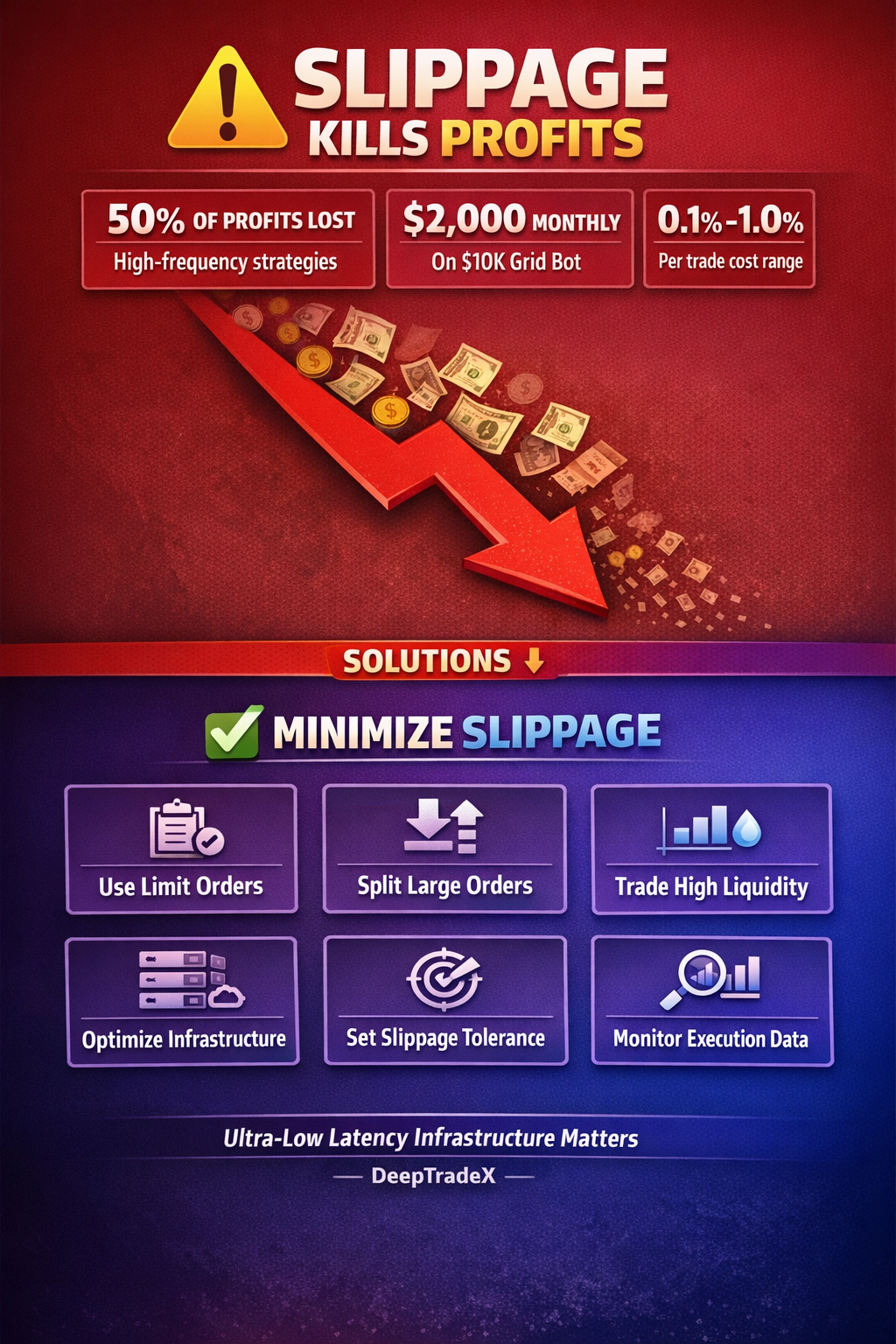
Slippage silently erodes trading profits — often more severely than exchange fees. You configure your bot to buy Bitcoin at $42,000, but execution happens at $42,084. That $84 difference might seem trivial on a single trade, but multiply it across hundreds of automated executions per month and you’re looking at thousands of dollars in hidden costs that transform profitable strategies into break-even disappointments.
In cryptocurrency markets, slippage ranges from 0.1% in highly liquid pairs to over 1% in thinly traded altcoins[¹]. For high-frequency strategies targeting 0.3–0.5% gains per trade, slippage alone can consume 30–50% of gross profits. When automated bots execute without slippage awareness, they amplify this problem through sheer volume — placing hundreds of trades that each suffer from execution price deterioration.
The difference between profitable automation and costly slippage often comes down to milliseconds of execution speed, proper order type selection, liquidity assessment, and infrastructure quality[²]. Understanding these factors and implementing targeted solutions separates traders who profit from those who watch returns vanish to invisible execution costs.
DeepTradeX delivers high-frequency trading infrastructure with hardware acceleration and ultra-low latency execution across 20+ integrated exchanges, minimizing slippage through optimized routing and institutional-grade execution quality[³].
This focused guide explains what causes slippage in automated trading, quantifies its real impact on returns, and provides six practical solutions you can implement immediately to reduce execution costs and protect profitability.
What Causes Slippage in Automated Trading
Slippage occurs when your executed price differs from the expected price due to market movement between order placement and execution, or insufficient liquidity to fill your order at the quoted price[¹].
Three primary factors drive slippage in cryptocurrency automated trading:
Market Movement During Execution happens when price changes in the microseconds between your bot deciding to trade and the order reaching the exchange. Even sub-second delays matter in volatile crypto markets where prices shift constantly. If Bitcoin moves from $42,000 to $42,050 in the 200 milliseconds your bot takes to execute, you’ve experienced $50 in slippage — your limit order won’t fill at $42,000, and a market order will execute at the new higher price[¹].
Insufficient Order Book Depth creates slippage when your order size exceeds available liquidity at the best price. If you want to buy $100,000 of ETH but only $50,000 is available at the best ask price of $3,000, the remaining $50,000 must fill at progressively worse prices — perhaps $3,005, then $3,010. Your average fill price becomes $3,007.50, creating $750 in slippage compared to the expected $3,000 entry[¹].
Exchange Latency and Infrastructure Quality determines how quickly your bot’s orders reach the exchange and execute. Professional trading firms achieve 1–2 millisecond execution through co-location and optimized infrastructure, while retail traders running bots from home computers or poorly configured cloud servers experience 100–300 millisecond delays — creating substantial slippage disadvantage during volatile periods[²].
Additional contributors include network congestion (especially on blockchain-based decentralized exchanges), API rate limiting causing delayed order placement, and bot logic that fails to account for current market conditions when sizing orders.
The Real Cost of Slippage on Bot Performance
To understand slippage impact, examine actual trade scenarios across different strategies and market conditions.
High-Frequency Strategy Example
A scalping bot targeting 0.3% profit per trade executes 50 trades daily. With average slippage of 0.15% per trade (0.075% entry + 0.075% exit), daily slippage costs accumulate:
Expected gross profit: 50 trades × 0.3% = 15% daily (unrealistic but illustrative)
Slippage cost: 50 trades × 0.15% = 7.5% daily
Net profit after slippage: 7.5% daily
Slippage consumes 50% of gross profits
Over a month (assuming compounding and realistic win rates), slippage transforms a strategy showing 10% monthly returns in backtesting into barely 5% in live execution — before accounting for exchange fees and other costs[¹].
Grid Bot in Volatile Market
A grid bot trading BTC/USDT with $10,000 capital executes 200 trades monthly during high volatility. Each trade suffers average 0.2% slippage:
Monthly slippage cost: 200 trades × 0.2% × $10,000 = $4,000 total exposure
Actual cost varies by trade size, but conservatively 0.2% per trade on $50 average = $10 per trade
Total monthly slippage: 200 × $10 = $2,000
On a $10,000 account, slippage costs 20% monthly
These numbers explain why backtested grid bot performance rarely matches live results — historical data doesn’t account for real-world execution costs[¹].
Arbitrage Strategy Impact
Arbitrage bots identify price differences across exchanges, but slippage determines whether opportunities remain profitable. If Bitcoin trades at $42,000 on Exchange A and $42,200 on Exchange B (0.48% spread), slippage considerations include:
Buy-side slippage on Exchange A: 0.1% = $42
Sell-side slippage on Exchange B: 0.1% = $42
Total slippage: $84
Gross profit from spread: $200
Slippage consumes 42% of the arbitrage spread
After exchange fees (typically 0.1% per side = $84), the $200 spread yields just $32 net profit — a 0.076% return requiring perfect execution. Any additional slippage eliminates profitability entirely[¹].
Six Solutions to Minimize Slippage
Implementing these practical strategies reduces slippage impact and protects automated trading profitability.
1. Use Limit Orders Instead of Market Orders
Market orders guarantee execution but accept whatever price the market offers — maximizing slippage during volatility. Limit orders specify your maximum buy price or minimum sell price, preventing execution at unfavorable rates.
The tradeoff: limit orders risk non-execution if price moves away from your limit. Configure your bot to use limit orders placed slightly above current ask (for buys) or slightly below current bid (for sells) — accepting minimal slippage in exchange for price protection[⁴].
Implementation: Set limit orders 0.1–0.2% from the current best price for liquid pairs, 0.3–0.5% for less liquid pairs. Monitor fill rates — if orders consistently fail to execute, widen the tolerance slightly until finding the optimal balance between slippage protection and execution certainty.
2. Split Large Orders Into Smaller Chunks
Large orders exceeding available liquidity at the best price inevitably suffer slippage as they consume multiple order book levels. Breaking a $100,000 buy into ten $10,000 orders reduces per-order market impact and allows the bot to find better average prices.
Order Splitting Strategy:
Calculate average order book depth at your target price levels
Size each chunk at 20–30% of available liquidity to minimize market impact
Space orders 30–60 seconds apart in normal volatility, 2–5 minutes during high volatility
Monitor for adverse price movement and pause further orders if price trends against your position
DeepTradeX’s AI-powered execution algorithms automatically optimize order sizing based on real-time liquidity analysis, splitting orders intelligently across 20+ exchanges to minimize slippage while maintaining execution speed[³].
3. Trade High-Liquidity Pairs During Peak Hours
Slippage correlates directly with liquidity — deeper order books mean your trades execute closer to expected prices. Focus automated strategies on high-volume pairs (BTC/USDT, ETH/USDT) rather than obscure altcoins with thin order books[⁵].
Timing matters as well. Crypto market liquidity peaks during overlapping trading hours when Asian, European, and US markets operate simultaneously (typically 12:00–20:00 UTC). Configuring your bot to increase activity during these windows and reduce trading during low-liquidity hours (00:00–06:00 UTC) measurably improves average execution quality.
Liquidity Assessment: Before deploying a bot on a trading pair, examine order book depth at ±0.5% and ±1% from current price. Pairs with less than $50,000 cumulative liquidity within ±0.5% present high slippage risk for strategies trading more than $1,000 per order.
4. Optimize Infrastructure and Reduce Latency
Execution speed directly impacts slippage. Every millisecond delay allows market prices to shift further from your intended entry. Professional-grade infrastructure reduces latency through:
Geographic Proximity: Cloud servers physically closer to exchange servers reduce network travel time. DeepTradeX’s infrastructure with hardware acceleration delivers ultra-low latency processing, capturing execution opportunities with minimal delay[³].
API Optimization: Efficient API integration using WebSocket connections for real-time data (rather than repeated REST API polling) provides faster market updates. When your bot sees price changes 100–200 milliseconds faster, it trades closer to optimal prices.
Direct Exchange Connections: Platforms supporting 15–20 exchange integrations enable cross-venue execution, letting your bot find the best available prices across multiple markets rather than accepting suboptimal fills on a single exchange[²].
Retail traders running bots from residential internet connections or low-tier cloud servers experience 100–300 millisecond execution delays compared to institutional 1–2 millisecond speeds — creating structural slippage disadvantage that compounds across thousands of trades[²].
5. Implement Slippage Tolerance Settings
Configure your bot with explicit slippage tolerance — the maximum acceptable difference between expected and executed price. If slippage would exceed this threshold, the bot cancels the trade rather than accepting unfavorable execution.
Recommended Tolerances by Strategy:
Scalping/High-frequency: 0.1–0.2% (tight control critical for small profit targets)
Grid trading: 0.2–0.3% (moderate tolerance for range-bound strategies)
Swing trading: 0.3–0.5% (longer timeframes tolerate wider slippage)
DCA bots: 0.5–1.0% (accumulation strategies less sensitive to exact entry)
Modern platforms allow dynamic slippage tolerance adjusting based on market volatility. During normal conditions, maintain tight tolerance (0.1–0.2%), but during high volatility periods when wider spreads are unavoidable, temporarily increase tolerance to 0.3–0.5% to maintain execution capability while still protecting against extreme slippage[⁴].
6. Monitor and Analyze Actual Slippage Data
Most traders configure bots once and ignore execution quality ongoing. Implement systematic slippage monitoring to identify patterns and optimization opportunities:
Key Metrics to Track:
Average slippage per trade (compare expected vs. actual execution prices)
Slippage by time of day (identify low-liquidity periods causing worse fills)
Slippage by order size (determine optimal trade sizing)
Slippage by exchange (identify which venues provide best execution)
Review slippage data weekly. If average slippage consistently exceeds your tolerance settings, investigate root causes: Are you trading during low-liquidity hours? Is your order sizing too large for available depth? Has overall market volatility increased requiring strategy adjustment?
Platforms providing transparent execution quality reporting enable data-driven optimization. DeepTradeX rigorously selects high-quality quantitative strategies with traceable performance data rather than theoretical backtests, helping users understand real execution costs[⁶].
FAQ
Q: What is the average slippage in crypto trading?
A: Slippage ranges from 0.1% in highly liquid pairs like BTC/USDT during normal market conditions to over 1% in thinly traded altcoins or during extreme volatility[¹]. Average slippage for automated traders typically falls between 0.15–0.3% per trade depending on strategy type, order sizing, and execution infrastructure. High-frequency strategies suffer more from cumulative slippage impact due to trade volume, while longer-timeframe strategies tolerate slightly higher per-trade slippage.
Q: Do limit orders eliminate slippage?
A: Limit orders reduce slippage by preventing execution at prices worse than your specified limit, but they don’t eliminate it entirely. You still experience opportunity cost slippage if price moves favorably while your limit order waits unfilled. Additionally, partial fills on limit orders create slippage as only portion of your intended position executes at the limit price while the remainder may require worse prices to complete[⁴]. Limit orders trade execution certainty for price protection — optimal for most automated strategies.
Q: How much slippage is acceptable in automated trading?
A: Acceptable slippage depends on strategy profit targets. For scalping strategies targeting 0.3–0.5% per trade, slippage above 0.15% consumes excessive profits. Swing trading strategies targeting 3–5% gains can tolerate 0.3–0.5% slippage. As a general rule, slippage should not exceed 20% of your per-trade profit target to maintain strategy viability. Configure slippage tolerance settings in your bot to automatically reject trades exceeding acceptable thresholds[¹].
Q: Does DeepTradeX reduce slippage compared to other platforms?
A: DeepTradeX delivers high-frequency trading infrastructure with hardware acceleration and ultra-low latency across 20+ integrated exchanges, providing execution quality approaching institutional standards[³]. The platform’s AI-driven execution algorithms automatically optimize order routing and sizing based on real-time liquidity analysis, meaningfully reducing slippage compared to standard retail bot infrastructure. Multi-exchange integration enables finding best available prices across venues rather than accepting suboptimal fills on single exchanges.
Conclusion: Protecting Profits Through Execution Excellence
Slippage represents one of the largest but most overlooked costs in automated cryptocurrency trading. While exchange fees receive scrutiny and backtesting results get analyzed extensively, execution quality silently determines whether strategies profit in live markets.
The six solutions — limit order usage, order splitting, high-liquidity focus, infrastructure optimization, slippage tolerance settings, and systematic monitoring — provide immediate actionable steps to reduce slippage impact. Implementation doesn’t require advanced technical knowledge, just conscious attention to execution details most traders ignore.
Platforms matter significantly. Infrastructure quality, exchange integrations, and execution algorithms create measurable slippage differences that compound across thousands of automated trades. DeepTradeX exemplifies institutional-grade execution accessible to retail traders through hardware-accelerated infrastructure, multi-exchange routing, and AI-powered order optimization[³].
The difference between profitable automation and break-even disappointment often comes down to execution quality. Traders focusing exclusively on strategy development while ignoring slippage fight with one hand tied behind their backs. Treating execution as seriously as strategy development — monitoring metrics, optimizing infrastructure, and continuously refining order management — separates those who profit from those who wonder why backtested performance never materializes in live trading.
Experience Low-Slippage Automated Trading
Ready to minimize slippage with institutional-grade infrastructure? DeepTradeX delivers ultra-low latency execution across 20+ exchanges with AI-powered order optimization. Join 20+ million users benefiting from superior execution quality: https://deeptradex.ai
References
1: HyroTrader, “Complete Guide to Automated Crypto Trading: What Actually Works,” January 2026. Slippage impact: “Slippage occurs when your executed price differs from the expected price due to market movement or low liquidity. On large orders or in illiquid pairs, slippage ranges from 0.1% in liquid markets to over 1% in thinly traded pairs. This blows holes through profits if ignored.” https://www.hyrotrader.com/blog/automated-crypto-trading/
2: Tickerly, “Trading Bot Crypto: Complete Guide to Automation 2026,” 2026. Execution speed importance: “The difference between profitable entries and costly slippage often comes down to milliseconds. Professional-grade crypto trading bots utilize optimized infrastructure with reduced latency. Professional firms execute in 1–2 milliseconds while retail traders run up to 100 times slower.” https://tickerly.net/trading-bot-crypto-complete-guide-2026/
3: DeepTradeX, “AI-Assisted Trading Platform,” 2026. Infrastructure quality: “DeepTradeX AI-Assisted Trading Platform. High-frequency trading infrastructure with hardware acceleration delivers ultra-low latency. Serving 20M+ Cumulative Signups across 20+ integrated exchanges.” https://www.deeptradex.ai
4: CoW Protocol, “What You Need to Know About Crypto Stop Market Orders in 2026,” 2026. Order types and slippage: “Stop limit orders add another layer by converting to a limit order instead of a market order when triggered. That reduces slippage risk but adds execution uncertainty. Limit orders specify maximum buy or minimum sell price, preventing execution at unfavorable rates.” https://cow.fi/learn/what-you-need-to-know-about-crypto-stop-market-orders-in-2026
5: Bitget Academy, “Crypto Trading Bots 2026: How They Work & Effectiveness,” 2026. Liquidity importance: “Liquidity depth across trading pairs determines available opportunities and slippage characteristics, with deeper markets supporting larger position sizes with minimal price impact.” https://www.bitget.com/amp/academy/crypto-trading-bots-1
6: Google Play Store, “DeepTradeX App Description,” 2026. Performance transparency: “DeepTradeX rigorously selects high-quality quantitative strategies with transparent, traceable data showing actual performance metrics rather than hypothetical backtests. Execution quality reporting enables data-driven optimization.” https://play.google.com/store/apps/details?id=com.x.deeptradex&hl=en_US