The promise sounds almost too good: deploy a trading bot, let it run 24/7, and watch profits accumulate while you sleep. Marketing materials showcase triple-digit returns, influencers flash screenshots of overnight gains, and platforms advertise “passive income” requiring zero effort. It’s tempting. It’s also misleading.
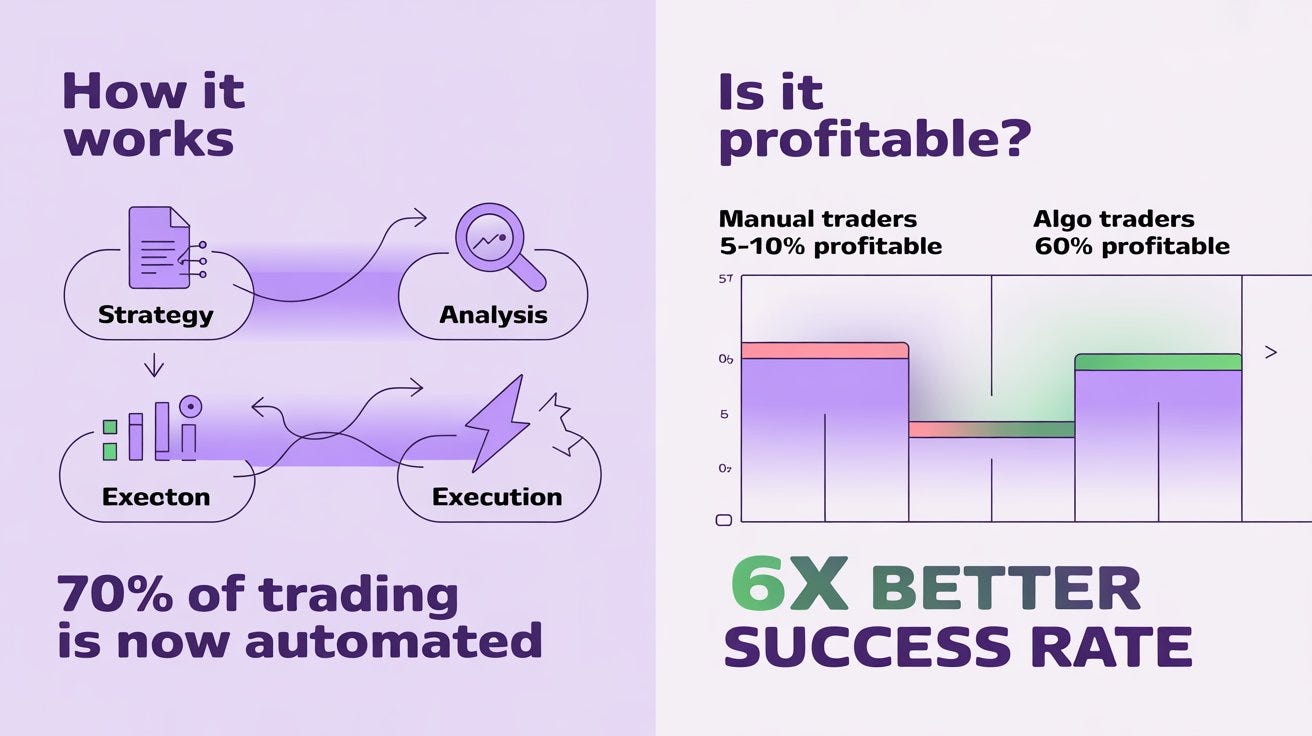
The truth about automated trading profitability sits somewhere between the utopian vision of effortless wealth and the cynical dismissal that “bots never work.” About 60% of retail algorithmic traders show positive annual returns — significantly better than the 5–10% success rate among manual day traders[¹]. Yet most of those automated traders still underperform simple buy-and-hold strategies, and less than 1% consistently profit after all fees are deducted[¹].
So which reality applies? Can automated trading actually generate profits, or does it simply lose money faster through technological efficiency?
The answer depends entirely on how you use it. Automation amplifies whatever strategy it executes — exceptional approaches scale beautifully, while flawed logic compounds losses at machine speed. Understanding how automated trading actually works, what determines profitability, and which factors separate successful deployment from expensive lessons helps investors make informed decisions about whether automation suits their approach.
DeepTradeX delivers institutional-grade automated trading accessible through one-click AI Agent activation, serving over 20 million users globally with strategies requiring zero coding knowledge[²]. The platform bridges AI intelligence with Web3 decentralization, enabling retail investors to deploy professional quantitative approaches previously available only to hedge funds with dedicated teams of quantitative analysts.
This comprehensive analysis examines how automated trading systems function, explores real profitability data from retail and institutional deployments, identifies the five critical factors determining whether automation will profit for you specifically, and provides honest guidance for investors considering this approach.
How Automated Trading Actually Works
Automated trading executes buy and sell decisions through computer programs following predefined rules, eliminating the need for constant human intervention while maintaining systematic adherence to strategy logic.
At its core, automated trading compresses the manual trading cycle — observe, analyze, decide, execute, monitor — into continuous machine-driven execution happening thousands of times faster than human capability.
The Three-Component Architecture
Strategy Definition establishes the exact conditions triggering trades. These rules range from simple (“buy when 50-day moving average crosses above 200-day”) to complex multi-factor models analyzing dozens of variables simultaneously. The strategy encodes your trading thesis into executable logic the computer follows with perfect consistency[³].
DeepTradeX offers pre-configured strategies spanning multiple risk profiles, each backtested across different market cycles and continuously refined through machine learning. Users select approaches matching their risk tolerance rather than building strategies from scratch — democratizing access to institutional-grade quantitative methods[⁴].
Market Analysis involves continuous monitoring of price data, volume, order books, technical indicators, and sometimes broader information like news sentiment or on-chain metrics. Automated systems process thousands of data points simultaneously — far exceeding human analytical capacity. They identify when current conditions match strategy criteria without fatigue, distraction, or emotional interference[⁵].
Modern AI trading bots use machine learning to analyze patterns and adapt to changing conditions. Through continuous learning, these systems refine which patterns predict profitable outcomes, improving performance over time as they accumulate experience[⁶].
Trade Execution happens automatically when analysis confirms strategy conditions are met. The system places orders on connected exchanges through API connections, managing position sizes, stop-losses, take-profits, and portfolio rebalancing without requiring manual button clicks[³].
High-frequency trading infrastructure with hardware acceleration delivers ultra-low latency measured in microseconds, capturing opportunities that exist too briefly for manual reaction. DeepTradeX’s trading infrastructure processes thousands of transactions across 20+ integrated exchanges with minimal latency, enabling strategies requiring rapid execution across multiple venues[²].
How It Differs From Manual Trading
Manual traders operate intermittently — checking charts periodically, analyzing when time permits, executing trades during waking hours. They miss approximately 66% of market hours simply because humans need sleep, work, and live their lives[⁷].
Automated systems provide full market coverage, monitoring positions and executing strategies regardless of time zones or your schedule. The bot manages risk during hours you sleep, captures opportunities while you work, and maintains consistent strategy execution without the emotional interference that destroys most manual trading accounts[⁵].
This doesn’t mean you deploy automation and never look again. Successful automated trading still requires periodic oversight (typically weekly reviews), strategy refinement as market conditions evolve, and intervention during unusual events. But moment-to-moment execution happens without your active involvement[⁷].
The Profitability Question: What Data Actually Shows
The word “can” does heavy lifting in the sentence “automated trading can be profitable” — because whether it profits for you depends entirely on factors within your control.
Success Rates: Better Than Manual, Far From Guaranteed
The most-cited trading statistic reveals that 89–95% of retail day traders lose money within a year. This sobering figure comes from multiple academic studies and broker disclosures covering all retail traders — including those trading on gut feeling at 2 AM after three cups of coffee[¹].
Narrow the lens to algorithmic traders specifically, and the picture shifts measurably. Around 60% of retail algorithmic traders show positive annual returns — a dramatic improvement over the 5–10% success rate among manual day traders[¹]. Automation eliminates some of the biggest profit killers: emotional entries, revenge trades, missed stop-losses, and fatigue-driven errors that bleed most manual traders dry.
The catch? “Positive returns” doesn’t mean “beating the market.” Many algo traders show gains trailing simple buy-and-hold strategies. And less than 1% of day traders — automated or not — consistently earn profits after all fees are deducted[¹]. Success means escaping the 89% failure rate, not joining the 1% generating life-changing returns.
Institutional Proof That The Model Works
If you want evidence that algorithmic trading generates real money, examine firms betting billions on it daily.
Renaissance Technologies’ Medallion Fund averaged 66% annual returns before fees since 1988, amounting to over $100 billion in total trading gains[¹]. D.E. Shaw’s Oculus fund returned 36.1% in 2024. Citadel’s Tactical Trading arm posted 22.3% that same year. Across the industry, quant hedge funds delivered $543 billion in investor gains in 2025 — the highest dollar figure on record[¹].
Jim Simons, founder of Renaissance, explained it simply: “Being right 50.75% of the time is enough.” The edge per trade is tiny. Consistency and scale make it enormous.
The honest caveat? These firms spend hundreds of millions on infrastructure, proprietary data, and PhDs in physics and mathematics. Their results prove algorithmic trading works at scale. But they don’t predict what your results will look like with a $5,000 account and a pre-configured strategy. Don’t confuse proof-of-concept with personal expectations.
Realistic Retail Bot Performance
Closer to typical investor experiences, retail bot data shows encouraging but modest results:
DCA bots on 3Commas averaged 18.7% annualized returns across 100 verified users over 12 months — impressive compared to failed manual traders, though data comes from platform self-reporting requiring healthy skepticism[¹].
Grid bots on Bitsgap showed 11% average 30-day returns before fees, with over 4.7 million bots launched. Real returns after costs prove far less impressive once exchange fees and slippage consume margins[¹].
Well-configured bots outperformed manual trading by 15–25% during volatile markets according to 2025 market studies[¹]. This advantage stems from 24/7 coverage and emotionless execution rather than superior intelligence.
AI-driven algorithms demonstrated 23% higher returns versus traditional strategies according to JP Morgan research cited across multiple industry analyses[¹]. DeepTradeX’s AI Strategy Bot analyzes millions of transactions across its 20+ million user base, identifying which strategies perform best under specific market conditions and automatically adapting parameters as environments evolve[⁸]. This adaptive intelligence means performance improves over time — a compounding advantage static rule-based bots cannot replicate.
Realistic first-year returns typically fall in the single-digit to low-teens percentage range. This won’t make you rich overnight, but it compounds meaningfully and beats being part of the 89% of manual traders who lose money.
One outlier worth mentioning: a Polymarket bot turned $313 into $438,000 in a single month by exploiting prediction market inefficiencies[¹]. Spectacular? Absolutely. Typical? Not remotely. Treat outliers as tail-end events, not benchmarks for building expectations.
Automated vs. Manual: The Data-Driven Comparison
Press enter or click to view image in full size
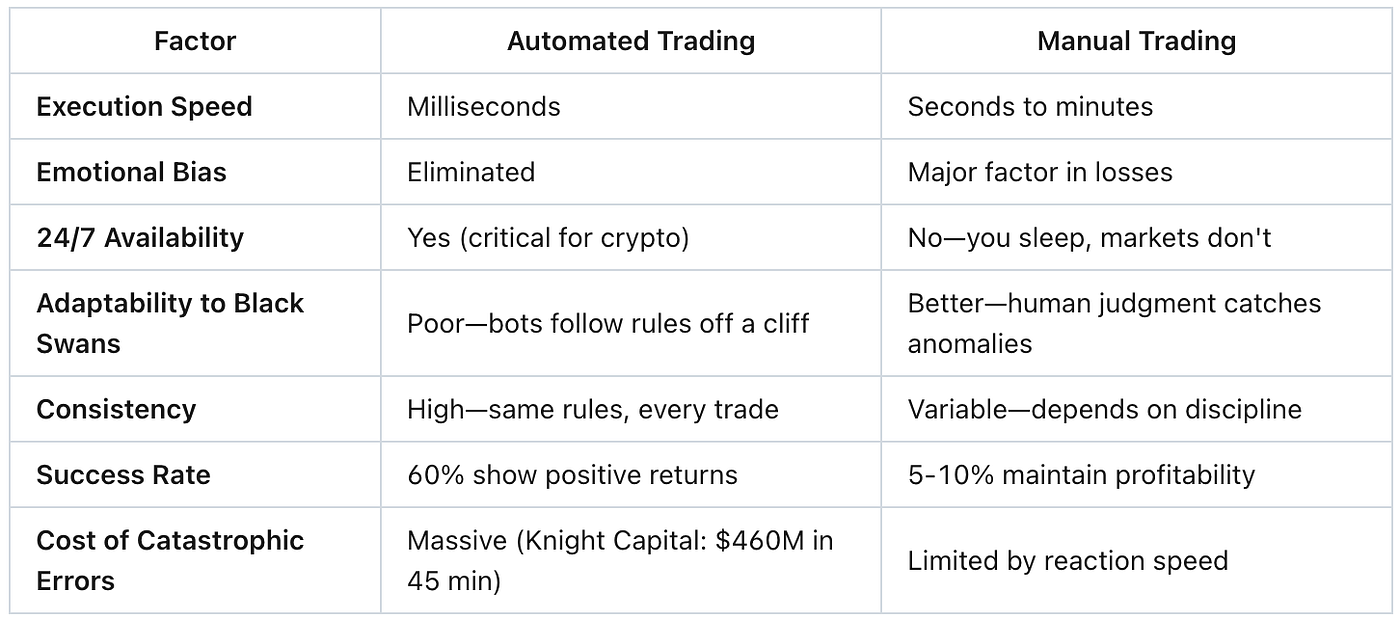
The 2025–2026 consensus among institutional and retail traders favors hybrid approaches: automation for speed, consistency, and 24/7 coverage; human oversight for strategy adaptation, black swan events, and regime changes bots cannot recognize[¹].
Five Factors Determining Whether Automated Trading Profits For You
The question isn’t “is automated trading profitable?” It’s “will it be profitable for you?” — and that answer depends on five specific factors within your control.
1. Strategy Quality: It All Starts Here
A bot amplifies whatever strategy it runs. Automate a profitable approach, and you scale gains. Automate a losing one, and you lose money faster and more efficiently than manual trading ever could.
Your bot needs a defined, statistically validated edge — not just a hunch that “this indicator looks promising.” If your strategy loses money when you test it manually, automation won’t fix it. It will simply execute the flawed logic with perfect consistency[³].
DeepTradeX rigorously selects high-quality quantitative strategies with transparent, traceable data showing actual performance metrics rather than theoretical backtests. The platform provides access to pre-configured approaches that have proven effectiveness across varied market conditions, eliminating the need to develop strategies from scratch[⁹].
2. Risk Management Matters More Than Win Rate
Professional traders profit with win rates as low as 25% by using 1:3 risk-reward ratios. Position sizing matters more than picking winners. Research on crypto systems showed that volatility-adjusted position sizing improved profit factors from 1.80 to 2.19 — a 22% improvement just from smarter sizing[¹].
Stop-losses, take-profits, and maximum drawdown limits aren’t optional features. They’re the difference between sustainable trading and account destruction. Automated systems execute these protections without emotional interference — you won’t talk yourself out of taking a stop-loss “just this once” when the bot follows rules regardless of hope or fear[⁵].
3. Execution Quality Determines Profitability Margins
Slippage ranges from 0.1% in liquid markets to over 1% in thinly traded pairs — blowing holes through profits if ignored. Choosing the wrong exchange reduces profits by up to 40% through higher fees, worse fills, and slower execution[¹].
Professional firms execute in 1–2 milliseconds while retail traders run up to 100 times slower. This explains why scalping bots live and die by execution quality — when targeting 0.1–0.3% moves, even fractions of a second delay change profitability math completely[¹].
DeepTradeX’s high-frequency trading infrastructure with hardware acceleration delivers ultra-low latency across 20+ exchanges, providing retail investors execution quality approaching institutional standards[²].
4. Market Condition Alignment
Every strategy has a sweet spot. Grid bots generate consistent returns in ranging markets yet hemorrhage capital in trends. Trend-following strategies thrive in momentum-driven markets but get whipsawed in choppy conditions. The ability to recognize when conditions have changed — and switch or pause accordingly — separates profitable traders from everyone else[¹].
Static rule-based bots continue executing the same approach regardless of whether conditions still suit that strategy. This explains why continuous learning AI systems like DeepTradeX’s AI Agent deliver advantages over fixed-logic bots — they adapt parameters as market regimes shift rather than blindly following outdated rules[⁸].
5. The “Set and Forget” Myth
“Set and forget” represents the single biggest myth in automated trading. Markets evolve. Strategies degrade as more traders exploit the same signals. API changes break connections. Parameters need adjustment. Regular performance review isn’t optional — it’s the difference between compounding gains and compounding losses[¹].
Profitable automation is reduced-attention income demanding periodic oversight, not zero-attention passive wealth. Minimum weekly reviews verify performance matches expectations and market conditions haven’t changed dramatically. Daily checks during high-volatility periods or major news events provide better risk management[⁷].
Common Mistakes That Destroy Profitability
Knowing what works matters. But knowing what destroys profits matters more.
Overfitting Strategies to Historical Data
Quantopian’s study of 888 algorithmic strategies found that backtest Sharpe ratios had near-zero predictive power for live returns. The more traders optimized strategies to fit historical data, the worse they performed in real markets. Over-optimized strategies lose up to 80% of their backtested profits when deployed live[¹].
The fix: keep strategies simple and use walk-forward analysis instead of static optimization. Fewer parameters mean less overfitting risk and more robust performance across varying conditions[¹].
Skipping The Testing Phase Entirely
Roughly 60% of retail traders skip proper backtesting before deploying real capital. Running an untested strategy live is the fastest way to discover it doesn’t work — and you discover with your own money[¹].
Platforms with demo exchange accounts let you validate strategies with real market prices without risking capital. Test extensively before going live. Paper trade for 30–60 days. Start with $100–500 in live capital. Only scale after 3+ months of consistent results[⁷].
Ignoring What Trading Actually Costs
A strategy showing 20% annual return in backtesting may yield only 5–10% after real costs. Grid bot testing illustrates this brutally — 1% daily paper returns shrank to 0.2% net after fees and slippage, an 80% degradation[¹].
Trading fees of 0.02–0.10% per trade compound with every execution. Slippage adds another 0.1–1% depending on liquidity. If your strategy isn’t profitable after costs, it isn’t profitable. Period.
Treating Bots Like Slot Machines
Bull market bots fail in bear markets. Strategies degrade as more traders copy the same signals. Exchanges update APIs which can break integrations silently. The solution: monthly performance reviews at minimum. Be willing to pause or adapt strategies when market conditions shift. Monitor for technical issues, not just returns[¹].
Going All In Too Fast
Deploying serious capital before a strategy proves itself live destroys accounts. Start conservatively: paper trade first, then $100–500 in live capital, only scaling after 3+ months of consistent results. No shortcuts[¹].
Cautionary Tales
Knight Capital lost $460 million in 45 minutes from a software bug — the company needed a $400M emergency bailout and was later acquired[¹]. LUNA crash: grid bots suffered 20–40% losses riding an asset to near-zero because they couldn’t recognize a death spiral[¹]. Leveraged grid bots during Q1 2024 market moves reportedly triggered hundreds of millions in liquidation losses[¹].
These aren’t scare stories. They’re evidence that risk management and testing are absolutely non-negotiable.
What It Actually Costs (And The Break-Even Math)
If you don’t know your costs, you don’t know if you’re actually profitable.
Typical cost components include platform subscriptions ($0–100+/month), exchange fees (0.02–0.10% per trade compounding with every execution), slippage (0.1–1%), spread costs, and potential VPS hosting ($5–20/month if needed)[¹].
Here’s the break-even math most traders don’t run before starting:
Press enter or click to view image in full size
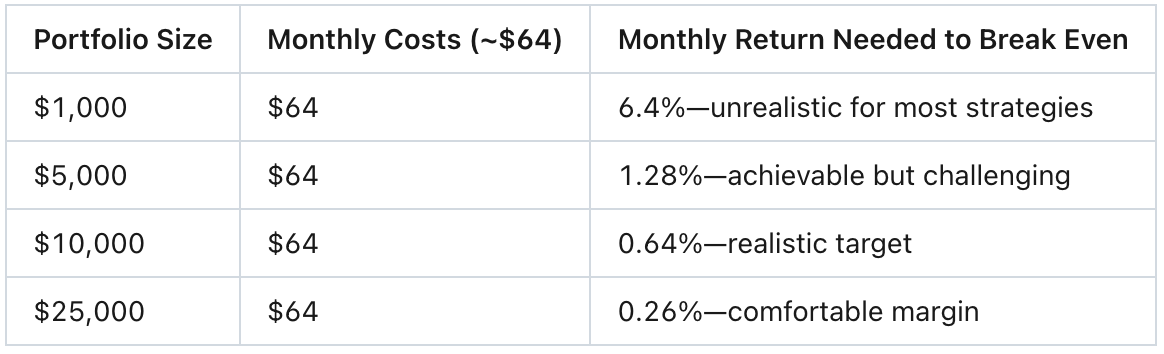
Platform cost structure directly affects net profitability. Flat-rate platforms with no per-trade fees become dramatically more cost-effective as trading volume increases, improving break-even math especially for active strategies and smaller portfolios[¹].
FAQ
Q: Can automated trading really be profitable for beginners?
A: Yes, with realistic expectations. About 60% of retail algorithmic traders show positive annual returns compared to just 5–10% of manual day traders[¹]. DCA bots averaged 18.7% annualized returns for beginners in verified studies[¹]. However, target 5–15% annually initially and always start with demo accounts before risking real money. It won’t make you rich overnight, but it beats being part of the 89% of manual traders who lose money.
Q: How much money do I need to start profitable automated trading?
A: You can start with $100–500 on most platforms, but $5,000+ provides comfortable break-even margins against platform costs. At typical costs of $64/month, a $5,000 portfolio needs just 1.28% monthly return to break even. Smaller accounts face fee erosion consuming larger percentages of profits. Larger starting capital ($10,000+) enables better risk management and diversification across multiple strategies[¹].
Q: What percentage of automated traders actually make money?
A: About 60% of retail algorithmic traders show positive annual returns[¹]. That sounds encouraging until you realize most still underperform buy-and-hold strategies, and less than 1% of all day traders — whether automated or manual — consistently profit net of all fees[¹]. Success means escaping the 89% failure rate, not necessarily beating market benchmarks. The bar for “profitable” matters significantly.
Q: Is automated trading more profitable than manual trading?
A: Data shows automated trading eliminates emotional biases, operates 24/7, and reduces execution errors. Bots outperformed manual trading by 15–25% in volatile crypto markets[¹]. However, manual trading adapts better to unprecedented events and regime changes. The emerging consensus favors hybrid approaches — automation for execution consistency, human oversight for strategy decisions and black swan recognition[¹].
Q: Can automated trading lose money?
A: Absolutely, and sometimes spectacularly. Knight Capital lost $460 million in 45 minutes from a software bug[¹]. LUNA grid bots lost 20–40% riding an asset to near-zero[¹]. Over-optimized strategies lose up to 80% of backtested profits in live trading[¹]. A bot amplifies whatever strategy it runs — including losing ones. This is why testing before deploying real capital is non-negotiable.
Q: How long before automated trading becomes profitable?
A: Most experts recommend 3–6 months of paper trading and strategy refinement, followed by 6–12 months of small-capital live trading to prove consistency. That’s a year or more before achieving reliable profitability. Rushing this timeline is among the top reasons traders fail. Treat the learning period as an investment in yourself, not a cost to minimize[¹]. DeepTradeX’s one-click AI Agent activation with pre-configured strategies shortens the learning curve by providing access to proven approaches rather than requiring strategy development from scratch[⁴].
Conclusion: Automation As Tool, Not Magic
Automated trading can be profitable — the 60% success rate among algo traders versus 5–10% among manual traders proves this[¹]. Institutional quant funds generating $543 billion in gains demonstrates the model works at scale[¹]. But “can be” carries critical qualifications.
Automation amplifies whatever strategy it executes. Deploy a sound approach with proper risk management, realistic expectations, and ongoing oversight — you gain measurable advantages over manual trading through consistency, speed, and 24/7 coverage. Deploy flawed logic hoping the bot will magically fix it — you lose money faster than manual trading ever could.
The five factors determining your profitability — strategy quality, risk management, execution quality, market alignment, and ongoing maintenance — sit entirely within your control. Understanding these factors, honestly assessing where you stand on each, and committing to continuous improvement separates the 60% who profit from the 40% who don’t.
DeepTradeX exemplifies democratization of institutional-grade tools through one-click AI Agent activation eliminating technical barriers, 20+ exchange integration providing multi-venue execution, continuous learning AI adapting to evolving markets, Web3 architecture maintaining user asset custody, and transparent performance data based on actual results rather than theoretical projections[²][⁴][⁸][⁹].
The question isn’t whether automated trading is profitable in general — data confirms it outperforms manual approaches for the majority. The question is whether you’ll implement it with the strategy quality, risk discipline, realistic expectations, and ongoing oversight that separate profitable deployment from expensive lessons.
Cryptocurrency markets never sleep. Neither do the algorithms capturing opportunities while manual traders rest. The gap between those using intelligent automation and those trading manually widens daily. The question is which side you’ll be on — and whether you’ll leverage tools that democratize institutional advantages or continue facing systematic disadvantages that compound every day you wait.
Experience AI-Driven Automated Trading
Ready to leverage institutional-grade automated trading with zero coding required? DeepTradeX delivers 24/7 AI-powered strategies across 20+ exchanges through one-click activation. Join 20+ million users benefiting from intelligent automation: https://deeptradex.ai
References
1: TV-Hub, “Is Automated Trading Profitable? Real Data & Guide [2026],” February 2026. Comprehensive profitability analysis: “About 60% of retail algo traders show positive annual returns compared to just 5–10% of manual day traders. Quant hedge funds pulled in $543 billion in investor gains in 2025. DCA bots averaged 18.7% annualized returns. Bots outperformed manual trading by 15–25% in volatile markets. Less than 1% of day traders consistently profit after all fees. Knight Capital lost $460M in 45 minutes from software bug. LUNA grid bots lost 20–40%. Over-optimized strategies lose up to 80% of backtested profits live.” https://www.tv-hub.org/guide/is-automated-trading-profitable
2: DeepTradeX, “AI-Assisted Trading Platform,” 2026. Platform capabilities: “DeepTradeX AI-Assisted Trading Platform. Experience Web3 trading with AI-Assisted Trading innovation. High-frequency trading infrastructure with hardware acceleration delivers ultra-low latency. Serving 20M+ Cumulative Signups across 20+ integrated exchanges.” https://www.deeptradex.ai
3: CMC Markets, “Automated Trading: Guide 2025,” 2025. Core mechanisms: “Automated trading refers to the use of computer programmes to execute trades in financial markets without constant human intervention. Strategy definition establishes rules determining when systems buy or sell. Trade execution happens automatically when analysis confirms conditions are met.” https://www.cmcmarkets.com/en/trading-strategy/what-is-automated-trading
4: DeepTradeX Support, “What is the DeepTradeX AI Agent?” 2025. Accessibility: “No Complex Setup Required, One-Click Activation. The strategies of the DeepTradeX AI Agent offer pre-configured quantitative approaches requiring zero technical expertise, with pre-built strategies spanning multiple risk profiles backtested across different market cycles.” https://deeptradex.zendesk.com/hc/en-us/articles/14655442632463-What-is-the-DeepTradeX-AI-Agent
5: KuCoin Learn, “What Are Crypto Trading Bots? A Beginner’s Guide,” 2025. Bot advantages: “A crypto trading bot is a computer program that uses artificial intelligence and advanced algorithms to automate the buying and selling of cryptocurrencies. These bots operate 24/7, remove emotional biases, and execute trades faster than humans. They analyze vast amounts of data and identify patterns that might be missed by human traders.” https://www.kucoin.com/learn/trading/what-are-crypto-trading-bots
6: Kraken Learn, “Crypto AI Trading Bots: A Complete Guide,” October 2025. AI capabilities: “AI-driven trading bots analyze market data, identify patterns, and adapt in real-time. Through machine learning, bots learn from historical data to identify patterns and make predictions. Reports indicate around 60–75% of trading volume comes from algorithmic systems.” https://www.kraken.com/learn/crypto-ai-trading-bots
7: HyroTrader, “Automated Crypto Trading Guide: What Works in 2026,” January 2026. Realistic expectations: “Profitable automation isn’t passive income that requires zero attention. It’s reduced-attention income that still demands periodic oversight. Minimum weekly reviews recommended. Manual traders miss 66% of market hours. Professional traders risk 1–2% of total capital per trade.” https://www.hyrotrader.com/blog/automated-crypto-trading/
8: DeepTradeX Support, “AI Strategy Bot Features,” 2025. Continuous learning: “The DeepTradeX AI Strategy Bot is designed to help users create more reliable strategy parameters and maximize their returns through large models trained for quantitative trading with continuous learning capability. The system analyzes millions of transactions, continuously learning which patterns predict profitable outcomes.” https://deeptradex.zendesk.com/hc/en-us/articles/14655442632463-What-is-the-DeepTradeX-AI-Agent
9: Google Play Store, “DeepTradeX App Description,” 2026. Quality transparency: “DeepTradeX rigorously selects high-quality quantitative strategies with transparent, traceable data showing actual performance metrics rather than hypothetical backtests. No technical expertise needed — users can deploy institutional-grade strategies with one-click activation." https://play.google.com/store/apps/details?id=com.x.deeptradex&hl=en_US