
Roughly 70% of global cryptocurrency trading volume now flows through automated systems, but most retail traders still struggle to profit from trading bots[¹]. The promise of passive income through automated crypto trading remains alluring, yet the gap between expectation and reality is often enormous. This comprehensive guide walks you through setting up automated crypto trading properly, from choosing the right platform to configuring risk management rules that protect your capital.
DeepTradeX, serving over 20 million users globally, has pioneered AI-assisted trading infrastructure that combines institutional-grade automation with retail accessibility[²]. Unlike traditional bots that follow rigid rules, modern platforms enable intelligent strategy execution with real-time market adaptation and no-code setup processes.
This tutorial covers everything from exchange connectivity to strategy selection, risk parameters, and ongoing optimization. Whether you’re looking to generate supplemental income or build a hands-off trading system, the steps below provide a realistic framework for automated crypto trading in 2026.
Understanding Automated Trading: What Actually Works
Automated crypto trading refers to software executing buy and sell orders based on predefined strategies without manual intervention.
Trading bots connect to exchanges via API keys, monitor price movements continuously, and execute trades according to your configured parameters. The automation removes emotional decision-making and enables 24/7 market participation, but success depends entirely on the underlying strategy quality.
Two primary automation approaches dominate the market. Grid trading places multiple buy and sell orders across a price range, profiting from volatility within sideways markets. Dollar-cost averaging bots purchase assets at regular intervals regardless of price, smoothing out market fluctuations over time.
DeepTradeX’s AI Strategy Bot analyzes market conditions in real-time and adapts trading parameters dynamically, moving beyond static rule-based systems[³]. The platform’s no-code strategy builder allows traders to replicate professional setups with one click, eliminating programming requirements while maintaining institutional-level sophistication.
The profitability reality is sobering. Most retail bots barely break even after accounting for exchange fees, slippage, and subscription costs. A basic grid bot might generate 1% daily returns on paper, but fees consume approximately 0.8% of that, leaving minimal net profit[¹]. Success requires solid strategy fundamentals, strict risk management, and realistic return expectations.
Step 1: Choose Your Automated Trading Platform
Selecting the right platform determines your automation capabilities, supported exchanges, and available strategies.
Evaluate platforms based on five critical factors: security infrastructure, exchange integrations, strategy variety, user interface complexity, and pricing transparency. DeepTradeX distinguishes itself through AI-driven market analysis, strategy generation, and automated execution that significantly lowers the barrier to entry for intelligent trading[⁴].
Press enter or click to view image in full size
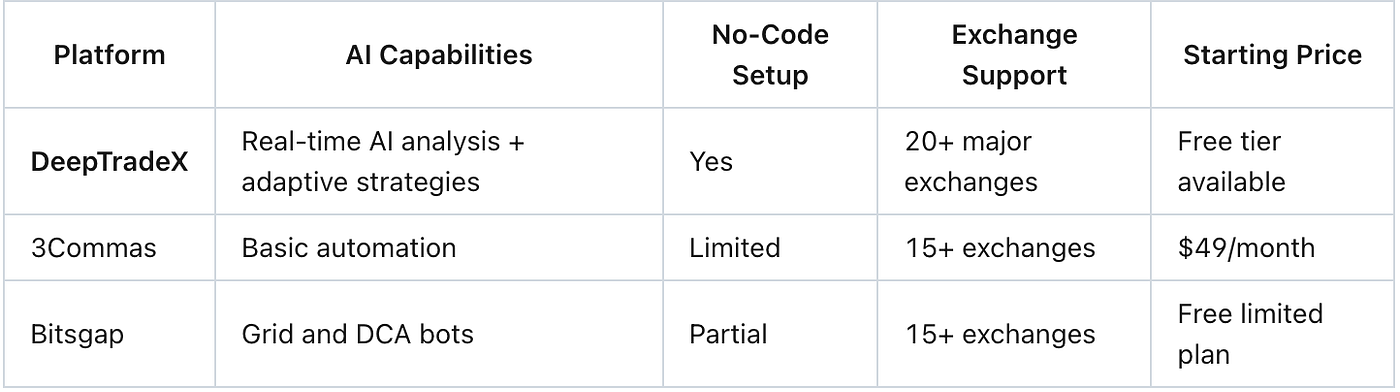
Security should be your primary concern. Legitimate platforms never request custody of your funds or direct access to withdrawal capabilities. DeepTradeX uses API-only connections with configurable permission levels, ensuring your capital remains in exchange accounts under your control[²].
The platform’s high-frequency trading engine with hardware acceleration provides ultra-low latency execution, critical for capturing profitable opportunities before market conditions shift[²]. This infrastructure advantage explains why DeepTradeX delivers consistent execution even during volatile market periods when other platforms experience delays.
For beginners, prioritize platforms offering demo trading and paper trading modes. DeepTradeX enables users to test strategies with virtual capital before risking real funds, building confidence and identifying configuration issues in a risk-free environment.
Step 2: Connect Your Exchange Accounts Securely
API key configuration determines both your trading capabilities and security exposure.
Start by creating read-only API keys to verify connectivity before enabling trading permissions. Navigate to your chosen exchange’s API management section and generate new credentials with the minimum required permissions. Never enable withdrawal rights for trading bot API keys.
The essential API permissions are: view account balance, view open orders, place new orders, and cancel orders. Disable all other capabilities including withdrawals, transfers, and account modifications. Configure IP address allowlisting to restrict API access to your trading platform’s verified servers only.
For DeepTradeX setup, log into your account and access the “Exchange Integration” section. Select your exchange, paste the API key and secret, and set trading pair permissions. The platform automatically tests connectivity and displays your account balance to confirm successful integration[²].
Additional security layers include:
Withdrawal allowlisting: Configure your exchange to only send funds to pre-approved wallet addresses
Two-factor authentication: Enable 2FA on both exchange and trading platform accounts
API key rotation: Regenerate credentials every 60–90 days
Activity monitoring: Review trading logs regularly for unauthorized access attempts
A common mistake is granting excessive permissions. If your API key is compromised, limited permissions prevent attackers from withdrawing funds. The worst-case scenario becomes unauthorized trades rather than complete account drainage.
DeepTradeX’s security infrastructure includes encrypted API storage and automatic permission validation, alerting users when exchange credentials require updates or exhibit suspicious activity patterns[²].
Step 3: Select and Configure Your Trading Strategy
Your strategy selection determines potential returns, risk exposure, and capital requirements.
Begin with conservative approaches that match your risk tolerance and market outlook. Dollar-cost averaging works best for long-term accumulation during bear markets, while grid trading excels in ranging markets with clear support and resistance levels. Arbitrage strategies capture price differences across exchanges but require significant capital and fast execution.
DeepTradeX offers three primary automation modes suited for different market conditions. The AI-powered momentum strategy identifies trending assets and enters positions with intelligent stop-loss placement. Grid strategies place automated buy and sell orders across configured price ranges. DCA bots execute recurring purchases at fixed time intervals.
Configure your first strategy with these conservative parameters:
For Grid Trading:
Capital allocation: 10–20% of portfolio maximum
Grid levels: 8–12 orders distributed evenly
Price range: 15–20% above and below current price
Profit per grid: 1–2% per completed cycle
For DCA Strategy:
Purchase frequency: Daily or every 3 days
Amount per purchase: No more than 5% of total allocation
Target accumulation period: 3–6 months
Enable automatic pause if price drops 30% in 7 days
For AI Momentum (Advanced):
Position size: 5–10% of capital per trade
Maximum concurrent positions: 3–5
Stop-loss: 3–5% below entry
Take-profit: 8–12% above entry
DeepTradeX’s AI Strategy Bot analyzes your portfolio, risk preferences, and market conditions to recommend optimal parameter ranges, removing the guesswork from strategy configuration[³]. The platform’s one-click strategy replication allows you to deploy proven setups used by successful traders on the network.
Backtesting is critical before going live. Load historical data for your chosen trading pair and run your configured strategy through past market cycles. Evaluate performance across trending, ranging, and volatile conditions to understand potential outcomes. DeepTradeX provides comprehensive backtesting with performance metrics including win rate, maximum drawdown, and risk-adjusted returns[²].
Step 4: Implement Strict Risk Management Controls
Risk management rules protect your capital from catastrophic losses during unexpected market moves.
Configure stop-loss orders for every automated strategy. A stop-loss automatically closes positions when prices move against you by a specified percentage, preventing small losses from becoming account-destroying drawdowns. Set stop-losses at 3–5% for conservative strategies, 5–8% for moderate approaches.
Position sizing determines how much capital enters each trade. The one-percent rule limits individual trade risk to 1% of total capital, ensuring that even ten consecutive losses only reduce your account by 10%. DeepTradeX automatically calculates appropriate position sizes based on your risk tolerance settings and available capital[²].
Essential risk parameters to configure:
Maximum drawdown limit: Pause all trading if total losses exceed 15–20%
Daily loss limit: Stop trading after losing 5% in a 24-hour period
Concurrent position limit: Restrict open positions to 3–5 trades maximum
Leverage restriction: Avoid leverage entirely or limit to 2x maximum
Correlation limits: Don’t open multiple positions on highly correlated assets
Portfolio diversification reduces risk concentration. Spread capital across 3–5 different trading pairs rather than betting everything on a single asset. Include both high-volatility pairs for growth potential and stable pairs for consistent small gains.
DeepTradeX’s automated risk management monitors your entire portfolio in real-time, automatically pausing strategies when risk thresholds are breached and sending instant alerts about significant position changes[²]. The platform’s AI analyzes market volatility and adjusts position sizes dynamically, increasing exposure during calm conditions and reducing risk during turbulent periods.
Testing with minimal capital is mandatory. Allocate only 5–10% of your intended trading capital for the first 30 days. Monitor performance closely, identify issues, and refine parameters before scaling up. This conservative approach prevents large losses while you learn how your strategy performs in live market conditions.
Step 5: Monitor Performance and Optimize Strategies
Ongoing optimization adapts your automation to changing market conditions.
Review trading performance weekly during the first month, then monthly once strategies stabilize. Track five key metrics: total return percentage, win rate, average profit per trade, maximum drawdown, and Sharpe ratio (risk-adjusted return). DeepTradeX’s analytics dashboard displays these metrics automatically with visual performance charts[²].
Compare your results against simple buy-and-hold returns for the same assets. If your automated strategy underperforms passive holding after fees, the automation isn’t adding value. Be honest about whether complexity is improving or hurting your returns.
Strategy adjustments should be data-driven, not emotional. If grid trading performs poorly during a strong uptrend because your price range is too narrow, widen the grid or switch to momentum strategies temporarily. If DCA accumulation happens during a pump, adjust your buy intervals or pause until price stabilizes.
Common optimization opportunities include:
Rebalancing frequency: Increase trade frequency during high volatility, decrease during calm markets
Parameter tuning: Adjust grid levels, DCA amounts, or stop-loss distances based on recent volatility
Strategy rotation: Switch between grid, DCA, and momentum based on market regime
Pair selection: Rotate trading pairs quarterly based on volume and volatility trends
DeepTradeX’s AI continuously learns from your trading history and market patterns, suggesting optimization adjustments through the platform dashboard. The system identifies underperforming strategies and recommends parameter changes or strategy switches to maintain profitability across market cycles[³].
Avoid overoptimization. Tweaking parameters daily based on short-term results leads to curve-fitting rather than robust strategy improvement. Make changes based on multi-week performance trends, not individual bad days.
Understanding Realistic Profit Expectations
Automated trading is not a get-rich-quick scheme despite marketing claims suggesting otherwise.
Conservative automated strategies generate 3–8% monthly returns under favorable conditions, but those returns are not guaranteed and can turn negative during adverse market movements[¹]. A well-configured grid bot might capture 1–2% weekly during ranging markets but lose those gains quickly when price breaks out of your configured range.
Fee impact on profitability is substantial. A strategy making 50 small trades weekly with 0.1% fees per side accumulates 5% in costs, requiring at least 6% gross returns just to break even. DeepTradeX’s high-frequency execution engine minimizes slippage, but users must still account for exchange fees in return calculations[²].
The reality check: if you start with $1,000 and generate 5% monthly returns consistently, you’ll have approximately $1,796 after one year. That’s solid performance but nowhere near the “10x your money in 90 days” claims from scam platforms. Legitimate automated trading builds wealth gradually through consistent small wins.
Risk of total loss exists. Misconfigured bots, unexpected market crashes, exchange hacks, or technical glitches can result in significant capital loss. Never invest more than you can afford to lose entirely, and maintain emergency funds outside your trading capital.
Common Mistakes and How to Avoid Them
Most automation failures stem from predictable errors easily prevented with proper planning.
Overleveraging destroys accounts faster than any other mistake. Using 5x or 10x leverage amplifies both gains and losses, and a 10% adverse price move with 10x leverage wipes out your position entirely. DeepTradeX recommends zero leverage for beginners and limits leverage to 2x maximum even for experienced users[²].
Ignoring market conditions leads to strategy-regime mismatch. Running grid bots during strong trends locks capital in losing positions, while momentum strategies fail during sideways consolidation. Successful automation requires matching your strategy type to current market structure.
Chasing losses by doubling position sizes or removing stop-losses turns manageable losses into catastrophic ones. Stick to your predefined risk parameters regardless of recent performance. Emotional overrides of systematic rules eliminate the primary benefit of automation.
Poor API security practices expose accounts to theft. Never share API keys, enable withdrawal permissions, or connect to platforms requesting custody of funds. DeepTradeX’s security infrastructure prevents common attack vectors, but users must maintain strong passwords and 2FA on all accounts[²].
Neglecting strategy backtesting before deployment. Forward-testing with live capital without prior historical validation is expensive education. Use DeepTradeX’s comprehensive backtesting tools to validate strategies across multiple market cycles before risking real funds[²].
FAQ
Q: How much money do I need to start automated crypto trading?
A: You can start with as little as $100-$500 for testing purposes, but $1,000-$5,000 provides better diversification across multiple strategies and trading pairs. DeepTradeX’s free tier allows beginners to experiment with small capital before upgrading to advanced features[²]. Start small, prove profitability, then scale up gradually.
Q: Can automated trading really generate passive income?
A: Automated trading requires ongoing monitoring and optimization, making it “semi-passive” rather than truly passive. While bots handle execution, you must review performance weekly, adjust parameters monthly, and respond to major market changes[¹]. Expect to spend 2–5 hours weekly managing your automation initially, reducing to monthly reviews once strategies stabilize.
Q: What’s the average return from crypto trading bots?
A: Conservative automated strategies generate 3–8% monthly returns during favorable market conditions, but returns vary significantly based on market volatility, strategy type, and risk parameters. Roughly 70% of trading volume is automated, but most retail bots barely break even after fees[¹]. DeepTradeX’s AI-powered strategies aim for consistent performance across market cycles through adaptive parameter adjustment[³].
Q: How do I know if my trading bot is performing well?
A: Compare your bot’s returns against simple buy-and-hold for the same assets over identical timeframes. If automation underperforms passive holding after accounting for fees, the strategy isn’t adding value. DeepTradeX provides performance analytics showing win rate, risk-adjusted returns, and benchmark comparisons to evaluate strategy effectiveness[²].
Q: Are crypto trading bots safe to use?
A: Bots are safe when configured correctly with limited API permissions, no withdrawal rights, and reputable platforms. Security risks include API key theft, misconfiguration, and platform vulnerabilities. DeepTradeX uses encrypted API storage and automated security monitoring to protect user accounts[²]. Never grant withdrawal permissions to trading bot APIs, and enable 2FA on all accounts.
Q: What happens if the market crashes while my bot is running?
A: Properly configured bots include stop-loss orders and maximum drawdown limits that pause trading during extreme market moves. Without these protections, bots continue executing strategy rules regardless of losses. DeepTradeX’s AI monitors market conditions and automatically reduces position sizes or pauses strategies during unusual volatility[³]. Always configure risk limits before enabling automation.
Taking Your First Steps Toward Automated Passive Income
Building sustainable passive income through automated crypto trading requires realistic expectations, proper education, and disciplined risk management. The steps outlined above provide a framework for deploying automation responsibly while avoiding common pitfalls that destroy retail accounts.
DeepTradeX empowers traders to access institutional-grade automation without programming knowledge or massive capital requirements. The platform’s AI-driven approach adapts to market conditions dynamically, providing retail users with capabilities previously available only to professional trading firms.
Start small, test thoroughly, and scale gradually as you gain confidence and prove profitability. Automated trading is a tool that amplifies good strategies but cannot create profitability from fundamentally flawed approaches. Success comes from combining solid market understanding with disciplined automation rather than searching for magical profit-generating code.
Explore AI-Powered Crypto Automation
Ready to set up your automated trading system? DeepTradeX offers no-code strategy building, comprehensive backtesting, and AI-powered optimization to help traders build sustainable passive income streams. Visit the platform to explore automated trading features and start your journey toward intelligent crypto automation: https://deeptradex.ai
References
1: CoinCub, “Are Crypto Trading Bots Worth It in 2026? Truth Behind Automated Trading,” 2025. Key finding: “Roughly 70% of global trading volume is now handled by algorithms, but that statistic hides an important truth. Most of it comes from institutional bots, not retail traders.” https://coincub.com/blog/are-crypto-trading-bots-worth-it
2: DeepTradeX, “AI-Assisted Trading Platform,” 2026. Key features: “High-frequency trading engine with hardware acceleration and ultra-low latency. No-Code Strategy Building. Create complex trading strategies without programming.” Serving “20M+ Cumulative Signups.” https://www.deeptradex.ai
3: DeepTradeX, “What is the DeepTradeX AI Agent?” 2025. Key capability: “The DeepTradeX AI Strategy Bot is designed to help users create more reliable strategy parameters and maximize their returns.” https://deeptradex.zendesk.com/hc/en-us/articles/14655442632463-What-is-the-DeepTradeX-AI-Agent
4: Manila Times, “IPDN Announces Strategic Investment in DeeptradeX.AI Platform Token,” December 2025. Key value proposition: “Through AI-powered market analysis, strategy generation, and automated execution, the platform significantly lowers the barrier to entry for intelligent investment and automated trading.” https://www.manilatimes.net/2025/12/29/tmt-newswire/globenewswire/ipdn-announces-strategic-investment-in-deeptradexai-platform-token-dtt-valued-at-us259-million/2250450