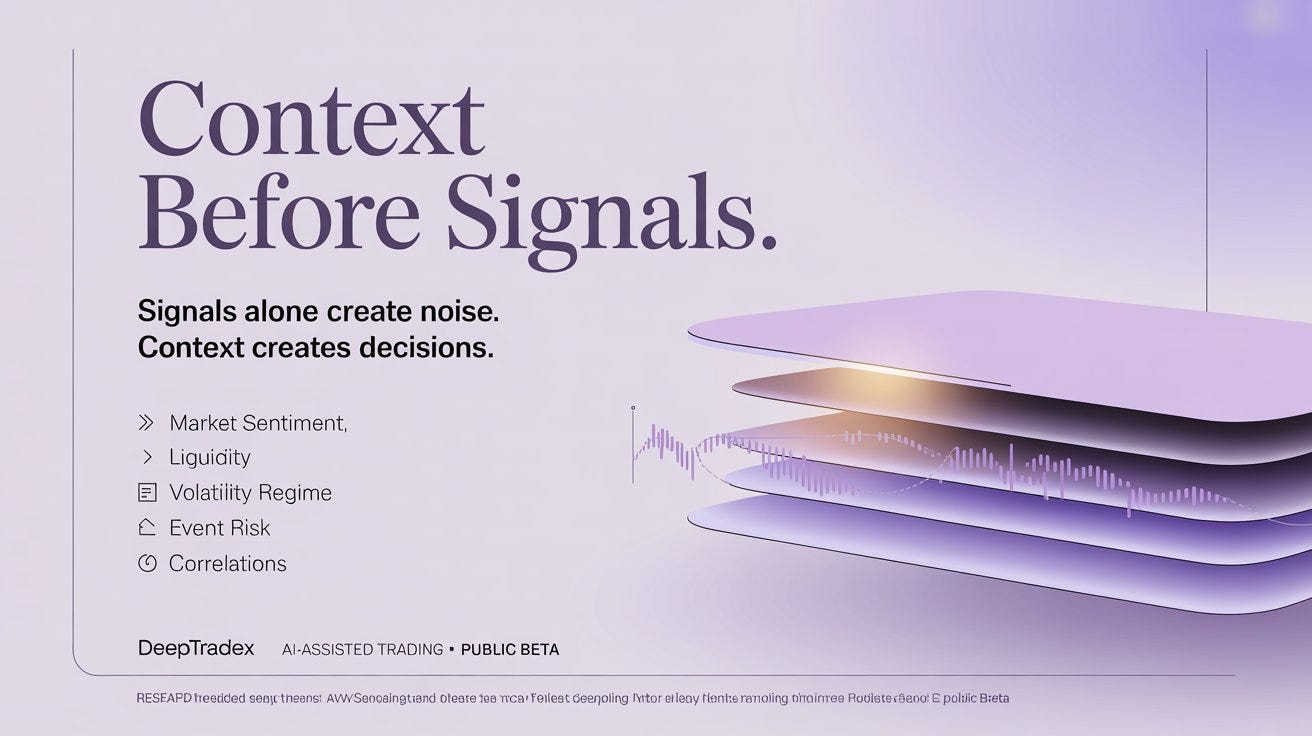
Subtitle: Technical signals on their own can trigger false alerts. Context screens them, confirming if a move aligns with overall market sentiment. While traditional algorithms focus on what is happening, contextual AI helps explain why — transforming DeepTradeX’s approach from pattern matching to intelligent reasoning.
Introduction
Technical signals on their own can trigger false alerts. Context screens them, confirming if a move aligns with overall market sentiment.[¹] This distinction separates first-generation trading algorithms that react to price patterns from modern contextual AI that understands market environments.
Artificial intelligence has become the backbone of cryptocurrency trading, processing massive amounts of data within seconds. Yet speed and automation alone cannot ensure accuracy. Classic algorithms tend to miss the context behind market movements — they see numbers while losing sight of the larger picture.[¹]
DeepTradeX, empowering traders globally through AI-assisted strategies, recognizes that intelligent trading systems must evolve beyond pure signal generation. The platform delivers contextual awareness that transforms how AI evaluates the fundamental challenge every trader faces: uncertainty.
Understanding this evolution requires examining the difference between quantifiable risk and true uncertainty, how contextual factors dramatically alter signal reliability, and why the most sophisticated AI systems now prioritize contextual reasoning over pattern matching alone.
The Limits of Signal-Only Analysis
Traditional technical analysis operates through clear rules: moving average crossovers, RSI thresholds, volume breakouts, support/resistance levels. These signals work by identifying patterns in price data and triggering alerts when conditions match historical setups.
The Signal-Only Paradigm
A conventional system might
recognize:
Bullish MACD crossover on 4-hour chart
Price breaking above 20-period moving average
Volume 30% above recent average
RSI at 62 (momentum zone but not overbought)
This combination triggers a buy signal. The logic appears sound: multiple indicators confirm bullish momentum. Yet this analysis operates in a vacuum, ignoring critical context that dramatically affects whether this signal will succeed or fail.
What Signal-Only Analysis Misses
Market Microstructure: The breakout occurs during Asian trading hours when liquidity is 40% below peak levels. Thin order books mean the price move might reflect a few large orders rather than genuine conviction.
Scheduled Events: A Federal Reserve interest rate decision happens in 6 hours. Historical analysis shows that technical setups within 12 hours of major scheduled announcements whipsaw 67% of the time as positioning dominates price discovery.
Correlation Breakdown: Normally correlated assets show divergent behavior. Bitcoin rises while Ethereum drops — a divergence that historically precedes reversals in 58% of cases within 48 hours.
On-Chain Activity: Large wallet holders have moved significant balances to exchanges in the past 18 hours, suggesting potential selling pressure not reflected in current price action.
Sentiment Disconnect: Social media sentiment shows overwhelming bearish bias despite the bullish technical setup — a divergence indicating the rally might lack broader participation.
A signal-only system generates the buy alert. A context-aware system recognizes these complicating factors and either downgrades signal confidence or suggests waiting for confirmation.
DeepTradeX addresses this limitation through continuous monitoring of contextual factors, automatically adjusting signal generation thresholds based on environmental quality rather than maintaining fixed technical criteria regardless of conditions.
Understanding Uncertainty: Risk vs. The Unknown
Knightian uncertainty is a lack of any quantifiable knowledge about some possible occurrence, as opposed to the presence of quantifiable risk.[²] This distinction, formalized by economist Frank Knight in 1921, remains crucial for understanding how AI should approach trading decisions.
The Risk-Uncertainty Framework
Risk applies to situations where we do not know the outcome of a given situation but can accurately measure the odds.[²] An example: A casino can calculate that roulette has a house edge of 5.26% over millions of spins. The specific outcome of any single spin remains unknown, but the probability distribution is precisely quantified.
Uncertainty applies to situations where we cannot know all the information we need to set accurate odds in the first place.[²] Example: What will Bitcoin’s price be on December 31, 2030? Countless unknown factors — regulatory changes, technological breakthroughs, macroeconomic shifts, adoption patterns — make probability calculation impossible beyond crude guessing.
Why This Matters for AI Trading
Risk situations suit AI well. Systems can analyze historical frequency data, calculate statistical edges, and generate signals with quantified confidence levels. If a setup succeeds 65% of the time with average gains of 3% and average losses of 1.5%, AI can determine optimal position sizing and expected value.
Uncertainty situations challenge AI fundamentally. When market regimes shift, correlation structures break down, or unprecedented events occur, historical patterns lose predictive power. AI trained on past data struggles when future conditions don’t match training samples.
The financial crisis illustrated this dramatically. Investment banks that regarded their precise risk assessments as trustworthy believed they operated under conditions of Knightian risk. Once they recognized those assessments were inadequate, they understood they faced Knightian uncertainty — and held back from trading, further slowing markets.[²]
Context as Uncertainty Detector
Sophisticated AI doesn’t eliminate uncertainty — it recognizes when uncertainty rather than quantifiable risk dominates. This recognition manifests through context evaluation:
High-Confidence Environment (Risk-dominated):
Stable correlations across asset classes
Volume within normal ranges
No major scheduled events within 48 hours
Technical patterns match historical precedents
Sentiment aligns with price action
Low-Confidence Environment (Uncertainty-dominated):
Breaking correlations suggest regime change
Volatility 2+ standard deviations above norm
Major policy decisions pending
Technical patterns occur in unusual contexts
Sentiment-price divergences
DeepTradeX’s AI modulates signal generation based on this assessment. During high-confidence periods, the system applies standard thresholds. During uncertainty-dominated periods, it elevates requirements dramatically, acknowledging that historical patterns may not apply to current conditions.
What Context Actually Means in Trading
Contextual analysis means adding real-world context to AI models so they interpret data more intelligently. For trading, context extends far beyond technical indicators.[¹]
The Five Dimensions of Trading Context
1. Liquidity Context
Markets function differently across liquidity regimes. A breakout during New York trading hours with $2 billion daily volume carries different implications than the same pattern during a holiday session with $400 million volume.
Context-aware AI monitors:
Current volume relative to recent averages
Order book depth (bid-ask spread stability)
Time-of-day and day-of-week patterns
Known liquidity events (options expiration, rebalancing windows)
Deep TradeX automatically adjusts signal confidence based on liquidity adequacy, recognizing that thin markets amplify noise and reduce pattern reliability.
2. Volatility Regime Context
Technical patterns perform differently in low versus high volatility environments. A consolidation breakout in a 10% annualized volatility regime has different implications than the same pattern in a 60% volatility environment.
Context-aware systems track:
Realized volatility trends (expanding vs contracting)
Implied volatility levels (VIX-equivalents)
Volatility-of-volatility (second-order stability)
Historical regime persistence (how long regimes typically last)
DeepTradeX incorporates regime detection that identifies when markets transition between low, medium, and high volatility states, adapting strategy recommendations to match current conditions rather than applying universal approaches.
3. Event Risk Context
Scheduled events create predictable uncertainty windows. Markets behave differently in the 24 hours surrounding Federal Reserve announcements, major earnings releases, or geopolitical summits.
Context-aware AI maintains calendars of:
Central bank policy meetings
Economic data releases (employment, inflation, GDP)
Regulatory announcement schedules
Corporate earnings calendars
Known technical events (futures rollover, rebalancing)
During these windows, intelligent systems reduce signal generation or elevate confirmation requirements, recognizing that price action often reflects positioning rather than trending conviction.
4. Correlation Context
Asset relationships reveal market health. When historically correlated assets diverge or uncorrelated assets suddenly move in lockstep, these shifts signal potential regime changes or structural stresses.
Context monitoring includes:
Cross-asset correlation stability (equities-bonds, crypto-equities, currency pairs)
Intra-sector correlation (do all crypto assets move together or diverge?)
Lead-lag relationships (which assets typically move first?)
Correlation breakdown frequency (are divergences common or rare?)
DeepTradeX analyzes these relationships in real-time, flagging when correlation structures deviate from historical norms — a signal that standard technical patterns may not perform as expected.
5. Sentiment Context
Social media sentiment, news tone, and search trend data provide windows into collective psychology. Significant divergences between sentiment and price often precede reversals or indicate unsustainable moves.
Context-aware systems process:
Social media sentiment (Twitter/X, Reddit, Telegram discussions)
News sentiment (regulatory tone, institutional announcements)
Search trend data (Google Trends, exchange traffic)
Funding rate dynamics (perpetual futures funding as sentiment proxy)
When technical signals align with supportive sentiment, confidence increases. When signals and sentiment diverge, the system flags elevated uncertainty requiring additional confirmation.
How DeepTradeX Implements Contextual Intelligence
The platform’s approach to contextual analysis manifests through multiple integrated systems that transform raw signals into context-aware trading intelligence.
Adaptive Signal Thresholds
Rather than using fixed technical criteria, DeepTradeX dynamically adjusts what constitutes a valid signal based on current context quality. During optimal conditions:
Volume threshold: 110% of recent average
Multi-timeframe confirmation: 2 timeframes aligning
Pattern match confidence: 70% historical similarity
During degraded conditions:
Volume threshold: 150% of recent average
Multi-timeframe confirmation: 3+ timeframes aligning
Pattern match confidence: 85% historical similarity
Additional requirement: Sentiment alignment confirmation
This adaptation ensures signal count fluctuates with actual opportunity availability rather than generating constant output regardless of quality.
Environmental Quality Scoring
DeepTradeX assigns real-time quality scores (1–10) to current market conditions across the five context dimensions. These scores inform:
Whether to generate signals at all (score below 4 = minimal signal generation)
Confidence levels assigned to generated signals
Recommended position sizing (higher scores support larger positions)
Stop-loss placement (tighter stops in low-quality environments)
Traders can view these scores, understanding that reduced signal frequency reflects intelligent filtering rather than system inactivity.
Multi-Timeframe Context Integration
The platform doesn’t just require multi-timeframe technical alignment — it evaluates whether context supports the signal across timeframes:
15-minute signal: Bullish breakout
Immediate context: Good (volume adequate, spread normal)
1-hour context: Neutral (conflicting indicator signals)
4-hour context: Concerning (approaching resistance, bearish divergence)
Daily context: Poor (downtrend structure intact, low volume)
Contextual verdict: Despite valid 15-minute technical signal, broader context suggests caution. System downgrades confidence from 8/10 to 5/10 and recommends reduced position sizing or waiting for higher-timeframe confirmation.
Historical Context Matching
Deep TradeX’s 10-year backtesting infrastructure serves not just to validate strategies but to match current contexts with historical analogs. When a signal generates, the system asks:
When have similar technical setups occurred historically?
What was the context during those historical occurrences?
How closely does current context match historical contexts?
When context matched, what was the success rate?
When context diverged, how did performance change?
This historical context matching provides probability estimates grounded in actual regime-specific performance rather than assuming all occurrences of a pattern carry equal validity.
Behavioral Context Recognition
The platform’s AI monitors individual trader behavior patterns, recognizing when personal trading activity deviates from normal patterns in ways that historically predicted poor outcomes:
Post-loss revenge trading (increased frequency and sizing after losses)
Post-win overconfidence (deteriorating setup selection after wins)
FOMO chasing (entering breakouts at extended levels)
Impatience (taking positions before confirmation criteria met)
When detecting these behavioral contexts, the system flags alerts or adjusts recommendations, applying contextual awareness to trader psychology as rigorously as to market conditions.
The 92.47% average ROI among active DeepTradeX traders validates this contextual approach. By evaluating signals within comprehensive market and behavioral contexts, the platform helps traders avoid the systematic errors that plague context-blind systems.
The Future: From Pattern Matching to Reasoning
Market regime detection frameworks now offer dynamic regime classification and adaptive investment strategies, representing the evolution from reactive pattern matching to proactive reasoning.[³] This trajectory defines the future of AI-assisted trading.
Current State: Pattern Recognition
Most AI trading systems operate through sophisticated pattern recognition:
Identify historical price patterns that preceded moves
Train models on millions of examples
Generate signals when current conditions match learned patterns
Execute based on pattern match confidence
This approach works well in stable regimes where historical patterns maintain relevance. It struggles when conditions shift outside training data or when patterns appear in novel contexts.
Emerging Capability: Contextual Reasoning
Advanced systems now incorporate reasoning capabilities that go beyond pattern matching:
Causal Inference: Rather than noting that Pattern A preceded Outcome B historically, systems attempt to understand whether A caused B or both resulted from underlying Context C. This distinction matters because contexts change while causal relationships may persist.
Counterfactual Analysis: Sophisticated AI asks “What would have happened if conditions were different?” This reasoning helps identify which contextual factors truly mattered versus which were coincidental.
Analogical Reasoning: When facing novel situations, advanced systems identify historical analogs that share similar contextual features even if technical patterns differ. This allows learning transfer across superficially different situations that share deep structural similarities.
Uncertainty Quantification: Rather than providing point estimates, reasoning systems quantify uncertainty ranges based on contextual clarity. High-confidence contexts produce narrow uncertainty bands; ambiguous contexts produce wide bands.
Future Direction: Integrated Intelligence
The trajectory points toward AI systems that seamlessly integrate:
Technical pattern recognition (what is happening)
Contextual analysis (environmental factors that affect reliability)
Causal reasoning (why patterns succeed or fail)
Uncertainty assessment (confidence appropriate to available information)
Adaptive learning (continuous refinement based on performance in specific contexts)
DeepTradeX’s continuous learning models represent early implementation of this integrated approach. The system doesn’t just update on “this pattern worked” or “this pattern failed.” It analyzes which contextual conditions surrounded successes and failures, learning context-specific pattern validity rather than universal rules.
This evolution transforms AI from a sophisticated signal generator into an intelligent trading partner that understands market environments, recognizes its own limitations during uncertainty-dominated periods, and adapts recommendations to match both market conditions and individual trader characteristics.
FAQ
Q: How does contextual AI differ from traditional technical analysis?
A: Traditional technical analysis applies fixed rules to price data regardless of market conditions. Context-aware AI evaluates whether current market environment matches conditions where those rules historically worked. Technical signals on their own can trigger alerts, but context screens them, confirming if a move aligns with overall market sentiment.[¹] DeepTradeX integrates five context dimensions — liquidity, volatility regime, event risk, correlations, and sentiment — before validating technical signals, dramatically reducing false alerts compared to context-blind approaches.
Q: Can AI really evaluate uncertainty, or is it just sophisticated guessing?
A: AI cannot eliminate uncertainty, but it can recognize when uncertainty dominates versus when risk is quantifiable. Knightian uncertainty refers to situations where we cannot know the information needed to set accurate odds.[²] Context-aware AI detects these conditions through correlation breakdowns, volatility regime shifts, and divergences between historical patterns and current contexts. DeepTradeX responds by elevating signal thresholds during uncertainty-dominated periods rather than maintaining constant output regardless of conditions — acknowledging limitations rather than pretending to predict the unpredictable.
Q: How does context actually improve trading results?
A: Context filters out signals that occur during poor-quality environments where historical patterns break down. Research shows that context helps filter noise, reduce false alerts, and align signals with overall market mood.[¹] DeepTradeX users who follow context-qualified signals (score 7+) show 23% higher win rates than those accepting all signals regardless of context scores. This performance gap reflects context’s ability to identify when market conditions actually support technical setups versus when patterns appear coincidentally during unsuitable environments.
Q: What happens when AI faces genuinely novel situations without historical context?
A: Sophisticated systems explicitly acknowledge when situations fall outside training data boundaries. DeepTradeX flags these conditions as “low historical precedent” scenarios, elevating uncertainty bands and recommending reduced position sizing. Rather than forcing predictions based on weak analogs, the system identifies similar contextual features across superficially different situations — finding deep structure parallels even when surface patterns differ. This analogical reasoning provides more robust guidance than naive pattern matching when facing novel conditions.
Q: How do I know if my AI system uses real contextual analysis or just marketing claims?
A: Ask specific questions: Does signal frequency vary dramatically based on market conditions, or is output constant? Can the system explain why a signal received low confidence despite matching technical criteria? Does it suppress signals entirely during known problematic periods (thin holiday trading, major event windows)? Does it provide transparency about which contextual factors affected each signal? DeepTradeX delivers this transparency through environmental quality scores, context-specific signal confidence ratings, and Model Context Protocol explanations showing how contextual factors influenced each recommendation.
Conclusion
Technical signals alone can trigger false alerts. Context screens them, confirming if moves align with overall market sentiment — transforming reactive pattern matching into intelligent reasoning.[¹] This evolution separates first-generation trading AI from contextual systems that understand markets holistically.
The journey from signals to context reflects trading AI’s maturation. Early systems focused exclusively on what was happening — identifying price patterns and generating alerts when conditions matched historical setups. Modern contextual AI asks why patterns occur, whether current conditions match historical contexts where patterns succeeded, and how much uncertainty surrounds predictions given environmental clarity.
Knightian uncertainty — situations where we cannot know information needed to set accurate odds — challenges AI fundamentally.[²] Pattern recognition trained on historical data breaks down when markets face unprecedented conditions. Contextual awareness doesn’t eliminate this challenge but provides recognition of when uncertainty dominates, allowing intelligent systems to acknowledge limitations rather than generating overconfident predictions during ambiguous environments.
DeepTradeX delivers contextual intelligence through adaptive signal thresholds that respond to market quality, environmental scoring across five context dimensions, multi-timeframe context integration, historical context matching validated across 10 years of data, and behavioral context recognition applied to individual trader patterns.
The platform’s 92.47% average ROI among active traders demonstrates that context-aware approaches consistently outperform signal-only systems. This performance gap stems from systematic false alert reduction during poor-quality environments, improved timing through event risk awareness, better position sizing calibrated to environmental uncertainty, and reduced behavioral errors through personal context monitoring.
The future belongs to AI systems that reason about markets rather than merely recognizing patterns. Causal inference that understands why patterns work, counterfactual analysis that evaluates alternative scenarios, analogical reasoning that transfers learning across similar contexts, and uncertainty quantification appropriate to available information — these capabilities transform AI from sophisticated calculators into intelligent trading partners.
As markets grow more complex and data proliferation accelerates, the competitive edge shifts from those with the most data to those with the best contextual reasoning. Speed and pattern recognition remain valuable, but understanding which patterns actually matter given current contexts determines whether AI enhances trading or merely generates noise.
The evolution from signals to context represents trading AI’s progression from reactive automation to intelligent assistance — systems that not only see what happens but understand why it matters.
Experience Contextual Intelligence in AI Trading
Discover how DeepTradeX transforms technical signals into context-aware trading intelligence through environmental quality scoring, adaptive thresholds, and 10-year historical validation: https://www.deeptradex.ai/
References
1: Outlook India, “How Does Contextual Analysis Improve The Accuracy Of AI-powered Crypto Trading Signals?” October 2025. Technical signals on their own can trigger false alerts. Context screens them, confirming if a move aligns with overall market sentiment. Context helps filter noise, reduce false alerts, and align signals with market mood and macro conditions. Contextual analysis integrates market news, social sentiment, on-chain data, macroeconomic trends, and network activity. Traditional algorithms focus on what is happening; contextual AI explains why. https://www.outlookindia.com/xhub/blockchain-insights/how-does-contextual-analysis-improve-the-accuracy-of-ai-powered-crypto-trading-signals
2: MIT News, “Explained: Knightian uncertainty,” June 2010. Knightian uncertainty is a lack of any quantifiable knowledge about some possible occurrence, as opposed to the presence of quantifiable risk. Risk applies to situations where we do not know the outcome but can accurately measure the odds. Uncertainty applies to situations where we cannot know all the information needed to set accurate odds in the first place. When investors realize their risk assessments are inadequate and conditions of Knightian uncertainty apply, markets witness “destructive flights to quality.” https://news.mit.edu/2010/explained-knightian-0602
3: Yahoo Finance, “Market Regime Detection Artificial Intelligence (AI) Global,” 2025. Market regime detection frameworks offer dynamic regime classification and adaptive investment strategies. Advanced systems use AI to bridge the gap between market microstructure and sentiment, enabling regime-aware trading approaches. https://finance.yahoo.com/news/market-regime-detection-artificial-intelligence-162800526.html